
Sage Solitaire is a solitaire variant from independent developer Zach Gage (STFJ LLC), the maker of SpellTower and Ridiculous Fishing, and it is one of the cleverest card games on iPhone and iPad. It throws out the table-sized layout of classic solitaire and rebuilds it for a portrait phone screen: nine piles of cards in a 3×3 grid, and instead of sorting cards by suit and rank, you clear them by making poker hands — pairs, straights, flushes, full houses — out of the face-up cards. It is free to download, with a single in-app purchase that removes the ads and unlocks extra modes. There are no levels to beat and no story to finish: every game is a fresh shuffled deal, and the goal is to clear the whole board and beat your best score.
This guide teaches the game in phases, because there are no fixed levels with fixed solutions — every deal is different. The rules and numbers below come from the App Store listing and from Pocket Gamer, Fast Company, Wikipedia and MobyGames, which agree on the core rules; where two sources disagree, I say so instead of picking one. Our Dinsun critic scored Sage Solitaire 80 out of 100, praising the solitaire-meets-poker idea, the one-handed design and the clean minimalist look, and warning that high-level play can feel luck-heavy and that progression is really just chasing high scores. My own take, after checking the listing and the player reviews: the free version is a complete game on its own, so try it free first and only pay for the extra modes if you are still playing it a week later.
Quick Facts
Developer: Zach Gage (STFJ LLC) | Price: Free, with one in-app purchase that removes ads and unlocks extra modes | App Store rating: 4.2 out of 5 (567 ratings, US) | Size: about 147 MB | Requires iOS 10.0 or later | Age rating: 4+ | Playtime: a single game takes a few minutes; there is no ending. The game was a 2015 App Store Game of the Year finalist. Version 2.1.2 (November 2020) is the current version, and the game has not been updated since — which matters, because the 2.0 update changed some rules, as explained below.
Get Sage Solitaire on the App Store
This is an unofficial fan guide and is not affiliated with Zach Gage or STFJ LLC. The rules were checked against the App Store listing, Pocket Gamer, Fast Company, Wikipedia and MobyGames. The game can change with updates, so treat this as a working route through the game, not gospel.
Watch the game first
If you have never seen the game, this is the official trailer from Zach Gage. It shows the 3×3 grid, the poker-hand scoring and the clean look of the game in about a minute, with no strategy spoiled. Click the picture to watch on YouTube.
 ▶
Watch: Sage Solitaire | Zach Gage (official trailer)
One honest note: I could not find a second verified video of this exact game on YouTube, so this post has just the one trailer. The BlueStacks page for the game embeds a generic BlueStacks video, not Sage Solitaire gameplay, so I did not use it.
Strategy 1: Learn the two rules that catch everyone out
Two rules from the published guides run the whole game, and both surprise new players. First, every hand you play must use cards from at least two different rows of the grid — you cannot make a pair from two cards sitting side by side on the same row, even if they match. Second, two pair is not a hand in the current version of the game: the 2.0 update removed it, and several long-time players complained about the change in their reviews, so if you learned the game before 2018, unlearn that one. Hands can be 2 to 5 cards: pair, three of a kind, straight, flush, full house, four of a kind, straight flush and royal flush. A hand only counts if the game recognises it, so tap your cards and watch for the hand name to appear before you commit.
Strategy 2: Play the bonus suit, and spend your trashes like money
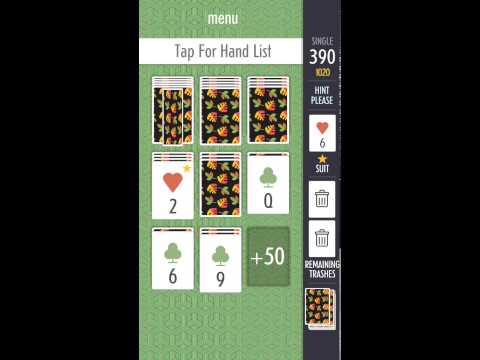
At the start of each game one card is taken out of the deck and its suit becomes the bonus suit for that game — the game uses 51 cards, not 52. Any hand that includes a card of the bonus suit scores double, so when you have a choice between two similar hands, take the one that uses the bonus suit. You also start with two trash tokens, which let you throw away a single face-up card without making a hand. One trash comes back every time you successfully play a hand, so you are rarely stuck at zero for long — but do not burn both trashes in the first minute. Save at least one for a card that is blocking a pile you need to clear, because a wasted trash early on is the most common way to strand yourself later.
Strategy 3: Attack the top row first — it holds nearly half the deck
This is the developer Zach Gage's own advice, given to Pocket Gamer, and it is the single most important habit in the game. The nine piles are not equal: from top to bottom, each pile holds 8, 8, 8, 7, 6, 5, 4, 3 and 2 cards. That means the top row alone holds 24 cards, while the bottom two rows combined hold 27. If you keep making easy hands from the bottom rows, you will run out of bottom cards while the top row is still full, and then there is nothing left to play with. Think in terms of the ratio of top cards to bottom cards: if a hand uses three bottom-row cards and no top-row cards, the ratio just got worse, and your next hand should use the top row. Use a trash on a top-row card when you need to, rather than letting the top row pile up.
Strategy 4: Think about "future memory" before you play a hand
Gage calls this future memory: every time you make a hand, you make the same type of hand more likely to appear in future. The reason is simple — making a straight removes cards that break up other straights, and the cards underneath tend to form straights too. So straights and full houses are powerful not just for their points, but because they breed more of themselves, and they break down into smaller hands (a 3-card straight, a three of a kind, a pair) that keep your options open. Flushes are the dangerous exception: a flush does not break down into a smaller hand, so if you make too many flushes early, you can end up with fewer than five piles left and no way to make a hand at all. A flush that is close to a straight flush is the safer kind, because it leaves the deck organised for straights. And when three cards show up on one row, do not panic — you are one pair away from a full house, or one card away from four of a kind, so try to build around them instead of trashing them away.
Strategy 5: Use the "Hint Please" button instead of guessing
If the rules feel confusing at first, you are not alone — even friendly reviews say the game is not immediately obvious. The game has a "Hint Please" button, and reviewers found it works better than a standard tutorial, because it shows you a legal hand on your actual board and you learn the rules by watching it work. Use it freely while you are learning, especially to see which hands the game recognises. Just remember the hint shows you a hand, not necessarily the best hand — once you understand the rules, check the bonus suit and the top-row ratio yourself before you play what it suggests.
Walkthrough 1: Your first game — clear the board in Single Deck
Start in Single Deck, the free default mode. You are dealt nine piles in a 3×3 grid, with only the top card of each pile face up. Your job is to clear all 51 cards. Tap two or more face-up cards from at least two different rows to make a poker hand, then tap the hand to play it: the cards disappear, points are added, and the next card in each pile flips over. Pairs are your bread and butter early on — two matching ranks from different rows. When you see three cards of the same rank across the rows, take the three of a kind; when you see three cards in sequence, take the 3-card straight. Clearing a whole pile earns a bonus that depends on which row the pile was in — but be warned, my two sources disagree on the exact values (Pocket Gamer says the top row pays the most, Fast Company says the bottom row does), so I am not printing numbers I cannot verify. Either way, an empty pile is good: it means nine fewer cards between you and a cleared board. You "win" by clearing every card, or by beating your previous high score — and a cleared board is rare at first, so do not be discouraged if your first dozen games end with cards still on the table.
Walkthrough 2: Scoring — what each hand is worth and why it matters
Hands score by type, with bigger and rarer hands worth more, and any hand that uses a card of the bonus suit scores double. That doubling is where the big scores come from: a full house with a bonus-suit card is worth far more than the same hand without one, so always scan the board for a bonus-suit card before settling on a hand. The exact point values per hand are shown in the game itself, and I am not listing them here because the game displays them as you play and they are the one thing you do not need to memorise. What matters is the order of priorities: first, any hand that clears a pile; second, any hand that uses the bonus suit; third, straights and full houses, because of future memory; and last, plain pairs, which keep the game moving but do little for your score. If no hand is available, that is what your trashes are for — throw away one blocking card and look again.
Walkthrough 3: The free modes — Single Deck, Vegas and Insta-Tournament
The free version deals out three modes. Single Deck is the standard game described above: one deck, 51 cards, chase the high score. Vegas adds betting: you stake virtual money on each game, and the bet level changes the risk. Gage's advice, again via Pocket Gamer, is that the lowest bets are best for grinding out cash to cover losses, because they are the only level where you can make money without clearing the board, while the highest bets lose you a lot of money if you do not clear the board — but pay out hugely if you do. Start low in Vegas until you can clear the board regularly. Insta-Tournament, added in the 2.0 update, deals the exact same shuffle to everyone in the world, and you compete on score for that one deal — it is the fairest way to see how good you actually are, because luck is the same for everyone. One player review warns that tournaments sometimes do not work; I could not verify that either way, so if a tournament fails to load, it may be the app, not your connection.
Walkthrough 4: The paid modes — Double Deck, Fifteens and True Grit
A single in-app purchase removes the ads and unlocks three more modes, plus wallpapers and themes. Double Deck plays the same game with two decks, so there are more cards, longer games and bigger hands. Fifteens adds a whole new way to clear cards: any cards that add up to 15 can be removed as a hand, which opens up combinations the other modes never allow. True Grit (also called Grit) plays like Vegas, but with a brutal twist: if you lose all your money and go below zero, you can never play True Grit again — that is permadeath for a card game, and Gage himself called it "how you do permadeath". Do not touch True Grit until you are comfortable in Vegas, and never bet your last dollars there. The purchase was $2.99 when the game launched in 2015; the App Store listing does not show the current price in the data I can check, so confirm it in the app before you buy. The free modes are the whole game for most players — the paid modes are for people who have already worn out Single Deck.
Walkthrough 5: Getting stuck — the endgame and the "no moves" trap
Most games end the same way: a few piles left, no legal hand on the board, and a trash or two in hand. Work through this order before you give up on a game. First, check every pair across rows — a pair is the easiest hand to miss, especially a low pair hiding among face cards. Second, check for 3-card straights: three cards in sequence across two or three rows, in any suits. Third, look for a flush you have been ignoring: five cards of one suit is a lot to assemble, but a 3-card flush does not exist — flushes need five cards, so do not waste time hunting for one with only three piles left. Fourth, spend a trash on the card that is blocking the tallest remaining pile, because revealing the card underneath it is often what unlocks the next hand. And finally, remember the top-row rule from Strategy 3: if you are stuck with only bottom-row cards left, the game was probably lost five hands ago, when you kept playing the easy bottom hands. Next game, attack the top row from the first hand.
Stuck? A short checklist before you look anything up
First, use the "Hint Please" button — it shows a legal hand on your actual board. Second, check the two-row rule: a pair on a single row is not a hand, and two pair is not a hand at all in the current version. Third, check the bonus suit: if a hand uses it, it scores double, and it is often worth waiting a turn for. Fourth, count your trashes — you start with two and earn one back per hand, so you usually have one to spend on a blocking card. Fifth, check the top-row ratio: if the top row is still tall while the bottom rows are nearly empty, you need to play top-row hands now, not later. And if a written step is hard to picture, watch the official trailer above — it shows the whole loop in about a minute.
Have you cleared the board in Sage Solitaire, or are you stuck somewhere else in the game? Tell us in the comments — and if you want the next walkthrough, tell us which game from our iOS list you want covered next.