
Rolling Sky is a fast-paced musical runner: you steer a ball left and right as it rolls forward on its own, dodging obstacles and gaps while the music sets the pace. It was released on January 20, 2016, developed by Minimax and originally published by Turbo Chilli before Cheetah Mobile took it over; the App Store listing now names Forward Vision Corporation Limited as the seller. There is no story to follow — the game is pure reflex and rhythm, one themed level at a time, and reaching 100% of a level without crashing or falling off the track is the whole goal. It is free on iPhone and iPad, and it is still being updated: version 5.7.0 arrived on November 27, 2026, adding a new Halloween bonus level, "Haunted Hunt". The fan wiki counts 247 levels in total, including 97 main levels, 89 bonus levels, co-creation levels and fan-made levels, so there is far more here than the five levels the game launched with.
This guide explains the controls and the ball, heart, shield and key economy first, then walks through the first five levels in release order — Massif, Sky, Forest, Desert and Volcano — using the published level guide and the fan wiki, which agree on the order and the traps in each. Where a tip comes from the App Store listing, the fan wiki or the 2016 Gazette Review guide, I say so. Where a level has changed since that 2016 guide was written, I say that too, instead of pretending the old layout is still exact. Our Dinsun critic scored Rolling Sky 62 out of 100 and called it a game to skip, but that score is mostly a penalty for having no story — Dinsun gave it 0 out of 10 for narrative, story and character, which do not apply to an abstract ball-roller — while its gameplay, visuals and audio scored 6, 7 and 8. Players on the App Store rate it 4.4 out of 5 from about 81,000 ratings. My own verdict, on the evidence below, is different from Dinsun's: this is a genuinely fun, polished free game in short bursts, carried by its music and its level variety, and the frustration is real but fair — the only purchase worth considering is the one that removes the two biggest frictions, balls and ads, which I cover in Strategy 4.
Quick Facts
Developer: Forward Vision Corporation Limited (Cheetah Mobile / Minimax) | Price: Free, with in-app purchases | App Store rating: 4.4 out of 5 (about 81,000 ratings) | Size: about 771 MB | Requires iOS 15.6 or later | Age rating: 9+ | Contains advertising, loot boxes and in-app purchases | Playtime: the Dinsun critic file estimates 5–10 hours to work through the early levels. Version 5.7.0 (November 27, 2026) adds the "Haunted Hunt" Halloween bonus level.
Get Rolling Sky on the App Store
This is an unofficial fan guide and is not affiliated with Minimax, Cheetah Mobile or Forward Vision Corporation Limited. Level details were checked against the Rolling Sky fan wiki and the Gazette Review level guide (August 2016), which agree on the first five levels in order. The game changes with updates — some levels have been split or reworked since 2016 — so treat this as a working route through the game, not gospel.
Watch the game first
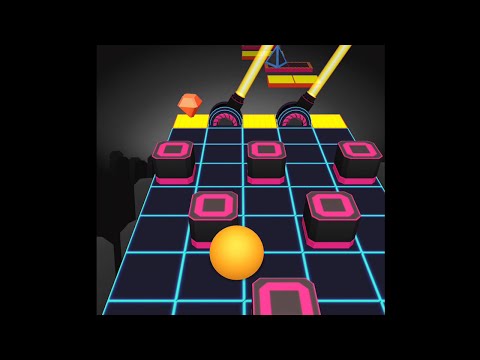
If you have never seen the game, this is the official gameplay trailer from Turbo Chilli, the game's original publisher. It shows the look of the levels, the ball, and the obstacles in under two minutes, with no solutions spoiled. Click the picture to watch on YouTube.
 ▶
Watch: Rolling Sky — Gameplay (Turbo Chilli)
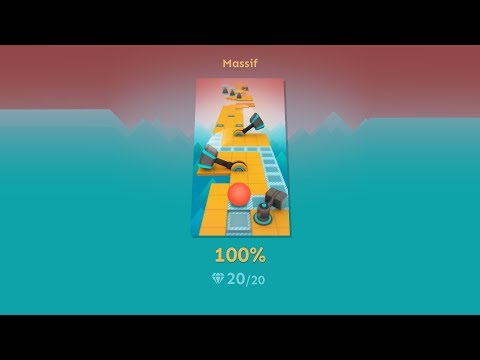
If you want to see the first level played all the way through, this fan video plays Massif from start to finish. Use it when a written step below is hard to picture. One honest note: it shows the classic version of Massif, and the level has since been split into A, B and C variants, so the layout may differ slightly from the version you play today. Click the picture to watch on YouTube.
 ▶
Watch: Rolling Sky — Massif (terux)
Strategy 1: Keep your finger behind the ball and never lift it
This is the single most important rule, and it comes from the Gazette Review guide. The controls are fluid and follow your finger exactly — they do not rely on slow swipes — so the smallest movement matters, and a momentary loss of control can cost you a ball. Keep your finger behind the ball, not in front of it: if your finger is in front, you cannot see the track and the obstacles ahead. Some players swear by an index finger, others by a thumb; there is no universal rule, so spend a few balls in Massif finding out which works for you. Do not lift your finger mid-level, even between obstacles — the ball keeps rolling whether you are steering or not.
Strategy 2: Look ahead, not at the ball
Your eyes should be a second or two up the track, reading the lane openings, not fixed on the ball itself. The music helps — the beat is a genuine timing cue, and the soundtrack is the best part of the game by every account, including Dinsun's — but the visual openings are the reliable cue when the beat and the obstacles disagree. The two most common failures are hitting a barrier and falling off an edge, and both are avoided by choosing a lane early, with one controlled move, rather than by frantic left-right corrections. The Gazette Review guide puts it well: move once per decision, then re-centre only when the next pattern allows it, because beginners often clear the first block and immediately steer back into the second one.
Strategy 3: Survival first, diamonds later
Every level has diamonds to collect — Massif has 20 — but do not chase them on your first runs. The Gazette Review guide is blunt about this: skip the gems for your first few attempts and focus on memorising the route, the safe paths and the obstacles, then come back for the collectibles once you know the level. A diamond near the centre of the track is usually safe; one near an outside edge can force a bad angle right before the next hazard, and that is how a good run ends at 90%. Expect to die at least a dozen times before you can even get to 50% of a new level — that is normal for this game, not a sign you are bad at it. Watch other players complete the level on YouTube before your first serious attempt, and treat each death as information about one specific spot.
Strategy 4: Spend balls, hearts, shields and keys wisely
The economy is the part of the game most likely to catch you out, so here it is in full, from the fan wiki and the live App Store listing. You hold a finite number of balls, and every failed attempt costs one. You get balls back by watching ads or by beating levels. A shield lets you survive crashing into one obstacle; a floating (called a float) saves you from one fall. Hearts let you revive from the last checkpoint in a level — checkpoints were added in 2017 — and a golden heart revives you exactly where you died, but the cost escalates if you use more than one in a single run: one golden heart, then two, then four, then eight. Reaching 100% of a level for the first time pays a key plus a reward of 10 balls, a shield or a floating, and you can double that reward by watching an ad. Keys unlock later levels, which cost 2–10 keys each, and most levels can also be unlocked permanently for free; if you are short of keys, you can unlock a level temporarily for five minutes by watching an ad. On the App Store, the in-app purchases include "Unlimited ball with no ads" for $3.99, "Upgrade" for $1.99, balls, hearts, shields and keys from $0.99 to $2.99, and "unlimited revive at checkpoint" for $3.99. My advice: never buy the $0.99 packs of balls, hearts or shields one at a time — they are the most expensive way to play. If you play daily and the ball limit keeps interrupting you, the only purchase worth considering is "Unlimited ball with no ads" at $3.99, because it removes the two biggest frictions at once.
Strategy 5: Learn one level at a time and trust the difficulty stars
Levels are rated from one to six stars, and that rating is a better guide than the song or the theme. Massif is one star; Sky is two; Forest and Desert are three; Volcano is four; and Happy Birthday, from 2018, was the first level rated six stars. Do not jump to a five-star level because you like the track — finish the level in front of you first. The level list on the fan wiki is ordered easiest to hardest, so if you are choosing what to play next, pick the lowest-star level you have not finished yet. And a warning for anyone following old videos: the Alan Walker and Marshmello levels (Alone, Faded, Alone II, The Spectre) were removed from the game after Cheetah Mobile's contracts with those artists expired, so if a video shows one of those, that level is no longer in the game unless you bought it before it was removed.
Walkthrough 1: Level 1 — Massif (1 star)
Massif is the first level and the gentlest one in the game: slow speed, wide spaces, and only 69 seconds long, with 20 diamonds to collect. It is the tutorial in all but name, and it is where you should learn the finger position from Strategy 1. The traps here are the easiest in the game — hammers that are simple to dodge, and trees that sprout out of the ground in front of you. Stay near the centre of the track, make small moves, and let the trees teach you the game's core lesson: the danger is not the obstacle you can see, it is the one that appears a beat later. Your first 100% finish here pays a key and a reward, which starts the unlock economy for the levels after it. If you can finish Massif without spending a shield, you are ready for Sky.
Walkthrough 2: Level 2 — Sky (2 stars)
Sky is where the game adds its second idea: gaps. The Gazette Review guide describes this level as full of gaps to jump across, coupled with moving platforms and an assortment of traps. Jump pads launch the ball over the gaps — your job is to steer onto the pad centred and land centred, not to fight the jump itself. Do not over-correct while you are in the air; pick your landing lane before you hit the pad. The moving platforms are the harder part: watch where a platform is going, not where it starts, and commit to the lane it is moving toward. Sky is still, in the guide's words, "somewhat easy" and a prelude to the harder levels — if Massif taught you to steer, Sky teaches you to time.
Walkthrough 3: Level 3 — Forest (3 stars)
Forest is a step faster than the first two levels, and the Gazette Review guide's description still holds: the start of the level has sprouting trees, moving platforms and some mid-air side movement. The opening is the hardest part, so spend your first few attempts learning just the first third — the sprouting trees punish anyone who charges ahead without looking. The good news, from the same guide, is that things get easier near the end, where the traps are very easy to avoid and act more like visual distractions than actual dangers. So the shape of a Forest run is: survive a hard opening, then relax into the back half. Do not spend a shield in the opening — save it for a mistake later in the run, when you are closer to 100%.
Walkthrough 4: Level 4 — Desert (3 stars)
Desert keeps the three-star difficulty but changes the traps. Now trees and walls both emerge from the ground, and quick reflexes are a must if you want to pass through a rising narrow gate without shattering. The set piece to learn is the emerging tunnel: you roll through it and then have to jump a gap while a laser beam fires on your position. Do not hesitate in the tunnel — the laser punishes waiting — and commit to the jump the moment the track opens up. This is the first level where the checkpoint-and-heart system really matters: if you die at the tunnel, a heart puts you back at the last checkpoint instead of the start, so a failed tunnel attempt costs one heart, not the whole run.
Walkthrough 5: Level 5 — Volcano (4 stars)
Volcano is the first four-star level, and the first one where the game stops being polite. Unlike the earlier levels, the colours here stay the same from start to finish — there is no visual breather — and the level is built from jumps, columns and moving platforms with rolling wheels. Halfway through, a run of split-second jumps is needed if you do not want to be blasted by the laser beams. The nastiest surprise, from the Gazette Review guide, comes right at the start: there is a very high chance you are killed by traps on the first moving platforms immediately after starting the level. The guide's fix is specific — stick to the right side and move toward the gems as the platform slides to the left — and it is worth following exactly on your first few runs. After Volcano, the next levels in release order are City (Level 6, four stars, narrow paths and muted colours that demand precision) and Sci-Tech (Level 7, four stars, with an arch that rises and falls, lasers and shifting blocks). From here on, use the difficulty stars from Strategy 5 to pick your next level — the road only gets steeper.
Stuck? A short checklist before you look anything up
First, check whether you are watching the ball instead of the track ahead — most "I keep dying at the same spot" moments are fixed by looking a second further up the track. Second, if one section keeps killing you, watch a playthrough of that level on YouTube first; the Massif video above shows the shape of a full clear. Third, if you are out of balls, watch an ad for more or beat an earlier level for its first-time reward — do not buy the $0.99 ball packs. Fourth, check the level's star rating before you blame yourself: a four-star level is meant to be hard, so drop back to an unfinished one-star or two-star level and come back later. And fifth, remember that the 2016 guide this walkthrough draws on describes the original versions of these levels — Massif has since been split into A, B and C variants, and other levels have been reworked too — so if a video shows a slightly different layout from the one on your phone, trust what is on your screen.
Have you finished Massif, or are you stuck somewhere else in Rolling Sky? Tell us in the comments — and if you want the next walkthrough, tell us which game from our iOS list you want covered next.