
Psych! Outwit Your Friends is a party trivia game from Warner Bros. and Ellen DeGeneres, made by the team behind Heads Up!. It is Balderdash on your phone: every round gives the group a real trivia question, everyone types a fake answer designed to sound true, and then everyone has to pick the real answer out of the pile. You score for guessing right, and you score again for every friend who picks your fake. It is free to download, and there is no campaign or level list to march through — a game is a set of rounds that lasts as long as your group wants it to — so this guide teaches the setup, the two kinds of deck, the bluffing and the scoring in order, instead of pretending there is a level-by-level route. One thing to know before you download: this is a group game only. There is no solo mode and no way to play against strangers or bots — every player needs the app on their own phone — so if you have no group to play with, there is nothing here for you.
Our Dinsun critic scored Psych! 65 out of 100, calling it "a fun, low-effort social game that relies entirely on the humor of your friends to be enjoyable", praising how easy it is to pick up and how good it is with a large group, while marking down the heavy monetization and ad presence, the useless solo experience and the repetitive questions. That 65 is one input, not this guide's verdict: my own judgment, from the App Store listing, the guides and player reviews, is that this is a good free download for game night and a skip for everyone else. With four or more friends in the room — or on a video call — the bluffing loop genuinely works, the free decks are enough for several sessions, and the only money the game really wants is for extra decks and removing ads. But the iOS version has not been updated since August 2023, the questions do repeat once you have played a lot, and the whole thing falls flat with a quiet or small group, exactly as Dinsun says. Two flags from the scores themselves: the critic file lists the value proposition as "Wait for Sale", which is wrong — the game is free, there is nothing to wait for a sale on — and Dinsun gave it 1 out of 10 for narrative, story and character, which drag the 65 down unfairly for a party game that has no story at all; fun scored 8 and performance 9, which is where this game actually lives. That also explains the gap with the App Store's 4.3 stars: players are rating the nights it works, Dinsun is rating the paywall and the nights it does not.
Quick Facts
Developer: Warner Bros. Entertainment | Price: Free, with in-app purchases ($0.99–$2.99) | App Store rating: 4.3 out of 5 (about 21K ratings) | Size: about 169 MB | Requires iOS 12.0 or later | Age rating: 13+ (infrequent mature/suggestive themes, sexual content and nudity) | Playtime: rounds-based party game, no campaign — a session lasts as long as your group wants. Version 10.10.160 was released on August 25, 2023. The game was first released on iOS on October 8, 2015.
Get Psych! Outwit Your Friends on the App Store
This is an unofficial fan guide and is not affiliated with Warner Bros. Entertainment or Ellen Digital Ventures. The mechanics below come from the App Store listing, the Google Play listing, the Vulcan Post hands-on, the Common Sense Media review and player guides, which agree with each other on the core loop; numbers that come from a single source are flagged as such. The game can change with updates, so treat this as a working route through the game, not gospel.
Watch the game first
The two videos below are both official and both about this exact game: the Warner Bros. trailer, and Ellen's own staff playing a full round on her show, which is the clearest look at how a round actually plays. Watch them to see the flow — question, fake answers, the big reveal, the scoreboard — before your first session. Click a picture to watch on YouTube.
 ▶
Watch: Psych! Outwit Your Friends trailer (Warner Bros. Rewind, official)
This second video is Ellen's staff playing the game on The Ellen Show, so you see real people writing fakes, arguing over which answer is true, and getting Psyched on camera. It is the best single demonstration of the game, because the whole joke of Psych! is watching your friends fall for your fake — and watching their faces when they do.
 ▶
Watch: Ellen's Staff Plays 'Psych!' (TheEllenShow, official)
Strategy 1: Write fakes that sound like the real answer, not like a joke
The whole game is the fake answer, and the beginner mistake is writing the funniest thing you can think of. A joke is easy to spot, and a spotted fake scores nothing. The winning fakes, per the guides and the Vulcan Post hands-on, are the ones that read like a trivia writer wrote them: proper grammar, a plausible name or number, the right shape for the question. If the question asks what year something happened, give a specific year, not "a long time ago". If it asks who invented something, invent a believable person with a believable job. And here is the twist the Vulcan Post writer discovered after twenty minutes: Psych!'s real answers are often ridiculous — did you know cotton candy was invented by a dentist? — so the silliest-sounding answer in the pile is often the true one. Write your fake to sound like the kind of weird fact the game actually asks about, and when you are voting, do not automatically dismiss the answer that sounds too strange to be real.
Strategy 2: In personal decks, read your friends, not the question
Trivia decks reward general knowledge; personal decks reward knowing the people in the room. In "The Truth Comes Out" the questions are about the players themselves — what is the last thing David googled, what does Jasmine spend too much time thinking about, what is Maria's hidden talent — and your fake is a guess about your friend, not a fact. The strategy flips: think about what the group already believes about that person, and write the answer they would expect to hear. If David is famously obsessed with his dog, a fake about dog food will pull votes even if the truth is about football. Likewise, when you are voting in a personal round, ask yourself which answer sounds like something your friend would actually do, not which one sounds most impressive. The guides agree this is where the biggest laughs come from, and also where the game is most unfair: the person who knows the group best has a real edge, so if you are the new friend at the table, play the trivia decks first and learn the group before you trust your instincts in a personal round.
Strategy 3: Do not joke every round — unpredictability is the weapon
If every fake you write is a gag, your friends learn to ignore your answers entirely, and your fakes stop pulling votes. The experienced-player advice from the guides is to mix it up: write a straight, plausible fake one round, then a funny one the next, so nobody can tell from the tone alone which answer is yours. The same goes for voting: if you always pick the funniest answer, the real one — which is often the dullest-sounding one in the pile — will slip past you. Keep your answers short, too. A long, elaborate fake gives itself away by trying too hard; a short answer that fits the question's format blends in. And watch the clock: answers are timed, so the player who freezes trying to craft the perfect fake ends up submitting nothing. A decent fake submitted in time beats a brilliant one that never arrives.
Strategy 4: Pick the deck for the room you are actually in
Psych! sells a lot of decks, and the wrong deck can sink a night. The free decks — Word Up, Movie Bluff and Is That a Fact? for trivia, plus The Truth Comes Out for personal questions — cover most groups, and the guides agree they are enough for several sessions. Save the paid decks for when the free questions start repeating: Animals and It's the Law at $0.99 each are the cheap trivia refreshers, while Caption This, Ice Breakers and Name that Show! at $0.99–$1.99 each add variety. Two decks need a warning: Adults Only and The Naked Truth, both $1.99, are adult decks with mature and suggestive content — the App Store rates the game 13+ for infrequent mature/suggestive themes and sexual content — so do not open them at a family game night, and do not buy them expecting more of the same trivia. The Party Pack at $2.99 bundles decks together and is the best value if you decide to pay at all. And if you are playing with the virtual Ellen — the game lets you add an Ellen DeGeneres player who submits her own answers — remember she is just another set of fakes in the pile, not a hint system; do not pick her answers because they sound official.
Strategy 5: Play free without paying — and know what the money actually buys
The download is free and the game is fully playable without spending anything: the free decks work, the room code works, and the scoring is the same. What the money buys is variety and quiet. Extra decks cost $0.99–$1.99 each (Party Pack $2.99), and Remove Ads is $2.99 — ads are the game's main free-player annoyance, and Dinsun lists the heavy monetization and ad presence as a core complaint, so if you play regularly the ad removal is the one purchase the guides and reviewers keep coming back to. Do not buy decks before you have played the free ones through a few sessions: the questions repeat eventually, but it takes a while, and a deck you buy for one night may sit unused after it. One more honest flag: the iOS version was last updated on August 25, 2023 — over two years ago — while the Android listing appears to have been updated more recently, in May 2026 according to one app-data site, so iOS players should not expect new decks or fixes to arrive soon. What you download today is, for practical purposes, the finished game.
Walkthrough 1: Setting up your first game — host, room code, everyone joins
Everyone in the group downloads Psych! on their own phone — one phone per player, no shared screen — and the host starts a game and picks a deck. A room code appears on the host's screen, and the other players enter that code to join the room. That is the whole setup, and it takes about a minute, but two things trip first-timers up. First, the game needs a constant internet connection, and Dinsun's critic file notes sync issues in large groups, so if someone's answers are not appearing, check their connection before you blame the game. Second, there is no way to play alone or with strangers: if only two of you are playing, the pile of answers is too small for the bluff to work, and the guides recommend 4–8 players for a balanced game, with 6–10 for the most laughter. Start with a trivia deck — Word Up is the most forgiving first pick — and save the personal decks for round two, once everyone understands the loop.
Walkthrough 2: Playing a trivia round — Word Up, Movie Bluff and Is That a Fact?
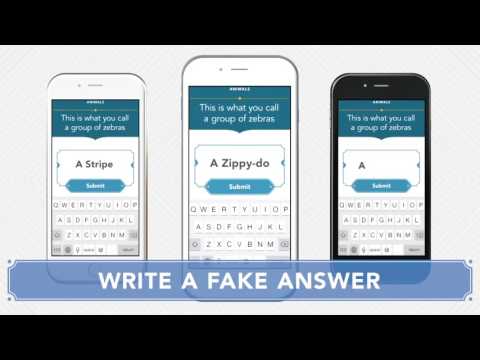
A trivia round runs the same way every time, and it is worth walking through once so nobody is confused mid-game. First, the question appears on everyone's phone — something like a strange fact about animals, movies or history. Second, everyone types a fake answer, racing a short timer. Third, all the answers appear together on screen, shuffled, with the real answer hidden among the fakes — nobody can see who wrote what. Fourth, everyone votes for the answer they believe is true. Fifth, the reveal: the game shows who wrote each fake, who got Psyched, and the updated scores. Points come from two places — guessing the real answer, and each friend who picks your fake — and the guides agree that a good fake often scores more than a correct guess, because one fake can fool several people at once. Play several rounds in the same deck before switching, because the first round is always the slowest while everyone learns the rhythm, and the game gets funnier once people stop overthinking their fakes.
Walkthrough 3: Playing a personal round — The Truth Comes Out
Personal decks change the game from trivia to gossip, and the round works the same way with one difference: the question is about someone in the room. The game will name a player — "What is the last thing David googled?" — and everyone except David writes what they think the answer is, while David writes the truth (or the game already knows it, depending on the deck). Then everyone votes on which answer is really David's. The trap here is writing what you wish were true instead of what is plausible: the fake that wins is the one the group believes about David, not the one that would be funniest if it were true. A practical tip from the guides: if you are the named player, do not react when your real answer appears in the pile — a laugh or a flinch gives it away, and your friends will all vote for it at once. And if your group includes people who barely know each other, skip the personal decks for the first night: the jokes only land when the group knows each other well enough for the fakes to sting.
Walkthrough 4: Scoring, winning and the long session — how a night actually plays out
There is no fixed number of rounds and no final boss: the host decides when the game ends, and the player with the most points wins. The scoring is simple — points for a correct guess, points for each player you Psych! — but the shape of a session matters more than the arithmetic. Early rounds are low-stakes while everyone learns the loop; by round three or four, players have a sense of each other's styles, and that is when the bluffing gets good, because you can start writing fakes aimed at specific friends. The guides' advice for the long session is to rotate decks rather than grinding one: a few rounds of Word Up, then a personal deck, then Movie Bluff, so the questions stay fresh and no one player type dominates — the trivia buff wins the trivia decks, the social butterfly wins the personal ones. If someone pulls far ahead, do not quit: a single great fake can fool the whole table and swing the scoreboard, which is why the game stays tense even when the lead looks safe. And when the questions start repeating — Dinsun's complaint, and a real one after many sessions — that is the signal to switch decks, not to keep playing the same one.
Walkthrough 5: Playing remote, playing with Ellen, and what to do when it goes wrong
Psych! works over a video call — the App Store description pitches it for Zoom calls, road trips and waiting in line — and the setup is the same: host, room code, everyone on their own phone, with the call open on a second device or in the background so you can hear each other react. Remote play is actually where the game shines, because you cannot see anyone's screen, so nobody can peek at your fake before voting. Two features to know about: you can add a virtual Ellen DeGeneres as a player, and she submits her own answers for the group to judge — fun for fans of the show, but not essential — and the game has leaderboards if your group wants a running rivalry across nights. When things go wrong, the fixes are boring but reliable: if answers are not syncing, check the connection and rejoin with the room code; if the game freezes mid-round, which older player reviews report during long sessions, restart the app and rejoin — your score for the round is usually lost, so treat it as a mulligan and move on; and if ads are interrupting the flow between rounds, that is what the $2.99 Remove Ads purchase is for, not a bug. If the game will not load at all, remember the iOS build is from August 2023 — it is an old app on new phones, and a reinstall is the first thing to try.
Stuck? A short checklist before you look anything up
First, check your group: if the game feels flat, you probably have too few players or the wrong deck for the room — you need at least four people, and a personal deck with strangers will fall flat, so switch to Word Up and try again. Second, check your fakes: if nobody ever picks yours, stop writing jokes and start writing answers that sound like a trivia writer wrote them — short, specific, plausible, in the right format for the question. Third, check your voting: if you keep picking the funniest answer, you are being Psyched on purpose — the real answer in this game is often the weirdest-sounding one, like the dentist who invented cotton candy, so give the strange answers a second look. Fourth, check the paywall: if you have run out of fresh questions, you do not need to buy anything yet — switch decks first, and only buy a $0.99 deck like Animals or It's the Law when the free ones are genuinely exhausted. Fifth, check the connection: if answers are not appearing or the game freezes, it is usually the internet, not your phone — rejoin with the room code, and if the iOS app keeps freezing on a long session, restart it and call the round a mulligan. And if you are playing alone, stop: there is no solo mode, no bots and no random opponents, so the only fix is to find three friends and a room code.
Have you Psyched your friends yet, or did the silliest answer turn out to be the real one? Tell us in the comments — and if you want the next walkthrough, tell us which game from our iOS list you want covered next.