
Gin Rummy Best Card Game is a free Gin Rummy app from GR GIN RUMMY AND GAMES LTD that does one thing and does it well: a clean, no-nonsense game of two-player Gin Rummy against an AI that adjusts to how good you are. There are no coins to farm, no energy timers and no flashy side modes — just the cards, a crisp table, and an opponent that gets tougher as you improve. It is free to download on iPhone and iPad, with an optional subscription to remove ads, and it has earned about 4.6 out of 5 from more than 233,000 App Store ratings. If you have never played Gin Rummy before, this is a good place to learn it; if you already know the game, the adjustable AI is the whole point.
This guide walks through the game in order, from your first deal to winning full matches against the hardest AI. Where a step comes from the App Store listing, I say so. The rules themselves follow standard Gin Rummy as set out by Pagat's Gin Rummy rules page and the how-to-play video linked below, and the strategy tips come from those same sources plus our own Dinsun critic's notes. Our Dinsun critic scored Gin Rummy Best Card Game 72 out of 100, praising the competent AI, the clean adult-focused interface and the fast gameplay, with the warnings being the subscription for ad-removal, limited multiplayer options and a fairly plain presentation.
Quick Facts
Developer: GR GIN RUMMY AND GAMES LTD | Price: Free, with in-app purchases (the App Store listing lists a subscription for ad removal at $3.99 a month, $19.99 for six months or $29.99 a year) | App Store rating: about 4.6 out of 5 (about 233,000 ratings) | Size: about 115.6 MB | Age rating: 12+ | Requires iOS 15.6 or later. The App Store listing promises an AI that auto-adjusts to your playing level, auto-save and resume, score and history tracking, and a choice of card decks, tables and themes.
Get Gin Rummy Best Card Game on the App Store
This is an unofficial fan guide and is not affiliated with GR GIN RUMMY AND GAMES LTD. The rules below follow Pagat's standard Gin Rummy rules and the how-to-play video linked below, and the app features come from the App Store listing. The game can change with updates, so treat this as a working route through the game, not gospel.
Watch the game first
If you have never played Gin Rummy, watch this first: a short, clear explanation of the whole game — melds, sets, runs, deadwood, knocking and going Gin, and how scoring works — in about nine minutes. Everything in this guide builds on it. Click the picture to watch on YouTube.
 ▶
Watch: Gin Rummy (2 players, Clear Rules) (Rulies)
Once you know the rules, this second video is the strategy companion to this guide: how to win at Gin Rummy — tracking discards, holding cards that block your opponent, and getting rid of high deadwood early. Watch it after your first few hands, when the ideas below start to make sense. Click the picture to watch on YouTube.
 ▶
Watch: How to Win Gin Rummy (Tactic Zoo)
Strategy 1: Learn the two melds before you play a single hand
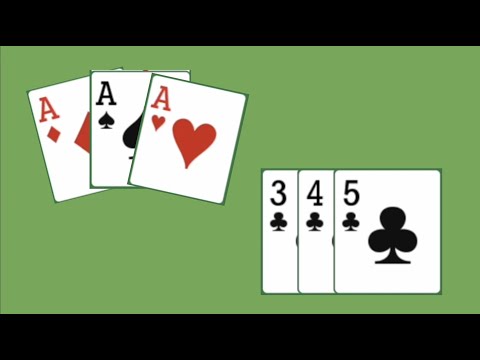
Everything in Gin Rummy is built from two shapes, and Pagat's rules page states them plainly. A set is three or four cards of the same rank, like 8 of clubs, 8 of diamonds and 8 of hearts. A run is three or more cards in sequence in the same suit, like 4, 5 and 6 of spades. Your whole job is to turn your ten cards into melds and leave as little deadwood — unmatched cards — as possible. Face cards are worth 10 points each, aces are worth 1, and the rest are worth their face value, so a king sitting unmatched in your hand is ten points of trouble. Before your first game, play the app's tutorial if it offers one, then play a few hands slowly: the app sorts and melds for you, but you need to be able to spot a set and a run at a glance before speed matters.
Strategy 2: Discard high deadwood early, and never feed the AI
This is the single most useful tip in the strategy video above, and it holds for every hand. On your first few turns, throw away your highest unmatched cards — kings, queens and jacks — because they cost you the most points if your opponent knocks. At the same time, watch what the AI picks up: if it takes a 6 of hearts from the discard pile, it is building around 6s or hearts, so do not discard a 5 or 7 of hearts, or another 6, for the rest of that hand. The app's AI adjusts to your level, so at higher difficulties it will punish exactly this kind of careless discard. A good habit is to check the discard pile before every draw: the card you are about to throw away might be the one card your opponent has been waiting for.
Strategy 3: Knock early and often — but watch for the undercut
You can knock and end the hand as soon as your deadwood totals 10 points or fewer, and you usually should: waiting for a perfect hand lets the AI knock first. When you knock, you score the difference between your deadwood and your opponent's — but if your opponent's deadwood is lower than yours, you have been undercut, and they score the difference plus a bonus instead. So before you knock, count twice: add up your unmatched cards, and ask whether the AI's hand could be better than yours. If the AI has been picking up low cards and discarding high ones, its deadwood is probably low, and knocking with 9 or 10 points is risky. Knock with 7 or fewer when you are unsure, and only chase the big 10-point knock when you have been watching the discards and the AI looks stuck.
Strategy 4: Going Gin is the goal, not a lucky accident
Going Gin means all ten of your cards form melds, with zero deadwood — and it pays a bonus on top of your opponent's deadwood. Do not treat it as something that just happens: build towards it. Keep pairs and two-card runs in your hand instead of breaking them up for a quick discard, and hold on to middle cards (5s through 9s) because they can complete runs in either direction, while a king can only ever join a run with a queen and a jack. Our Dinsun critic notes the AI is genuinely competent and plays with a strategy that mimics a real opponent, so at the higher difficulties it will go Gin on you if you play slowly — speed matters. If your hand is one card away from Gin and the AI knocks first, that is the game telling you to play faster, not to play safer.
Strategy 5: Use the AI difficulty as a ladder, and save your progress
The App Store listing's headline feature is an AI that auto-adjusts to your playing level, and the app lets you play against AI opponents at different strengths. Treat that as a ladder: start low while you learn the melds and the knock timing, and move up only when you are winning comfortably — a jump in difficulty is the fastest way to find the holes in your game, because a stronger AI will undercut your sloppy knocks and go Gin on your slow hands. The app auto-saves and resumes, so use it: if you have to close the app mid-match, your game is waiting for you, and the score and history tracking lets you see whether you are actually improving or just having a lucky streak. Do not pay for the subscription until you know you like the game — the free game is the full game, and the subscription only removes the ads.
Walkthrough 1: Your first hand — the deal and the first draw
Each player is dealt ten cards from a standard 52-card deck, one card is turned face up to start the discard pile, and the rest become the draw pile. On your turn you draw one card — either the face-up card from the discard pile or the top card of the draw pile — and then you discard one card. Your first job in any hand is a quick sort: which cards already form melds, which cards are one away from a meld, and which cards are deadwood. The app does the sorting and melding for you, so use that first screen to read your hand before you touch anything. Draw from the discard pile only when the card completes or extends a meld; otherwise take the unknown card from the draw pile, because the discard pile tells your opponent exactly what you are building.
Walkthrough 2: Building melds and shedding deadwood
Play the middle of the hand like this: every turn, draw, then discard your worst deadwood — highest points first, as Strategy 2 says. Keep pairs together, because a pair plus one draw is a set; keep two cards of a run together for the same reason. Watch the AI's discards as closely as your own hand: if it throws away a card, it does not need that rank or suit, which makes it safe for you to discard similar cards. The hand usually lasts a dozen turns or so, and the shape of it is always the same — your deadwood count falls turn by turn, and the player whose deadwood reaches 10 or fewer first gets to decide whether to knock. If your deadwood stalls above 10 for several turns, you are holding the wrong cards: look for a pair or a two-card run you broke up by mistake, and rebuild around it.
Walkthrough 3: Knocking — ending the hand on your terms
When your deadwood is 10 or fewer, the app will let you knock. Do the count first: add up every unmatched card in your hand, face cards at 10, aces at 1. If the total is 7 or less, knock — the undercut risk is small and the points are worth taking. At 8 to 10, knock only if the AI has been discarding high cards and looks stuck; if it has been picking up low cards, wait one more turn and try to shed another point or two. When you knock, both hands are shown: your opponent can lay off their deadwood cards against your melds, which can shrink your score, so a knock with a big meld showing is worth more than a knock with small melds. If you knock and your opponent undercuts you, do not tilt — note what they were building, and do not feed them the same cards next hand.
Walkthrough 4: Going Gin and the big hands
The best hands end in Gin: all ten cards melded, zero deadwood, a bonus on top of whatever your opponent is holding. You will know you are close when your hand has one deadwood card left and a draw away from a meld — at that point, stop knocking even if you could, and play one more turn for the Gin. Big Gin is the rarer version, where you go Gin with eleven cards after drawing, and it pays more again. The risk is real: while you chase Gin, the AI may knock and end the hand, leaving you with whatever deadwood you still hold. So chase Gin only when your deadwood is already low — five or fewer — and the AI has not shown signs of being close to knocking. Our Dinsun critic's verdict is that the AI plays a real strategy rather than just cheating, so a strong AI will spot a Gin chase and knock early to cut it off; against the harder opponents, take the knock and the safe points instead.
Walkthrough 5: Winning the match — scoring, multiplayer and the AI ladder
Hands keep coming until one player reaches the match target, and the score carries over from hand to hand — so a match is won by consistent small wins, not one lucky Gin. After each hand, check the score and history the app tracks: if you are winning hands but losing matches, you are probably knocking too late or chasing Gin too often. Once you are beating the AI at your current level, step the difficulty up — that is the game's real progression, since there are no levels or unlocks to grind. The app also offers online multiplayer and Game Center matches against real players, where the same rules apply but the tells are human: real opponents bluff with discards and hold cards longer, so the discard-tracking habit from Strategy 2 matters even more. Our Dinsun critic reached the Expert AI level in about 15 hours on an iPhone 15 Pro, and rated gameplay 8 out of 10 and mechanics 8 out of 10 — the game is at its best as a serious solo card game, not a social one, so expect the multiplayer options to feel limited compared with the solo AI game.
Stuck? A short checklist before you look anything up
First, re-count your deadwood — most "I can't knock" moments are a miscount, and face cards are 10 points each, not their face value. Second, check your discards: if the AI keeps winning, you are probably feeding it the cards it needs, so stop taking from the discard pile and watch what it picks up. Third, knock sooner — waiting for Gin while the AI knocks first is the most common way to lose a winning hand. Fourth, if your deadwood will not drop below 10, look for a pair or two-card run you split up and rebuild around it. Fifth, step the AI difficulty down one notch while you practise a new habit, then step it back up — the app adjusts to you, but you learn faster when you choose the step yourself. And if a rule still does not make sense, re-watch the Rulies how-to-play video above — it covers every rule in this guide in about nine minutes.
Have you beaten the Expert AI, or are you stuck on a hand that will not come together? Tell us in the comments — and if you want the next walkthrough, tell us which game from our iOS list you want covered next.