
Backgammon - Lord of the Board is a free online backgammon app from Beach Bum Ltd. that turns the world's oldest board game into quick player-versus-player matches on your iPhone or iPad. You play classic backgammon — 15 checkers each, two dice, a doubling cube — against real opponents around the world, with live tournaments, leaderboards, chat, and boards and dice to unlock as you level up. It is free to download, with a welcome bonus of coins to start, daily bonuses and optional in-app purchases for more coins and cosmetic boards. Our Dinsun critic scored Backgammon - Lord of the Board 48 out of 100, praising the fast matchmaking, the polished boards and sound, and the well-run tournaments, with the warnings being that the coin economy pushes hard at you, many players distrust the dice, and the pop-ups and social requests get in the way.
This guide walks through the game in order, phase by phase. One honest note up front: Lord of the Board is an endless series of matches against real people, not a game with a fixed list of levels to solve one by one. There is no final boss and no published per-level solution to copy, because every match deals you a fresh board and a fresh opponent. So instead of pretending there is a fixed answer for "match 47", this guide teaches the game the way it is actually played — the rules, the doubling cube, the race to bear off and the coin economy — in the order you meet them, so you can play any match the game deals you. Where a tip comes from the App Store listing, from a published backgammon guide, or from player reviews, I say so.
Quick Facts
Developer: Beach Bum Ltd. | Price: Free, with in-app purchases | App Store rating: 4.5 out of 5 (about 88,781 ratings) | Size: about 325 MB | Requires iOS 15.0 or later | Age rating: 12+ | Version: 10.7.488 (updated 2026-11-17) | Playtime: Endless — there is no finish line. The App Store listing promises "quick backgammon play", "live tournaments", "playful chat options", "player statistics profiles" and "lots of free bonuses, rings, trophies, prizes & more". Similar games our Dinsun critic names: Backgammon Plus, Chess.com and Monopoly Go!
Get Backgammon - Lord of the Board on the App Store
This is an unofficial fan guide and is not affiliated with Beach Bum Ltd. Tips were checked against the App Store listing, the Backgammon Galaxy beginner tutorial and published backgammon rules guides (JackGammon and Howcast), which agree on the rules below, plus the developer's own support pages on earning coins. The game can change with updates, so treat this as a working route through the game, not gospel. Lord of the Board uses virtual coins only — there is no real-money gambling in the app and coins cannot be cashed out.
Watch the game first
If you have never seen the game, this first video shows real gameplay from this exact app — a Lord of the Board match in progress, so you can see the board, the dice and how a real player moves. Click the picture to watch on YouTube.
 ▶
The second video is not this app — it is a general backgammon tutorial, and I am labelling it honestly as one. Professional player and coach Justin Nowell explains the whole game in about eleven minutes: the starting setup, hitting, bearing off, the doubling cube, gammons and match scoring. That is exactly the foundation you need before opening Lord of the Board for the first time, because the app assumes you already know the rules.
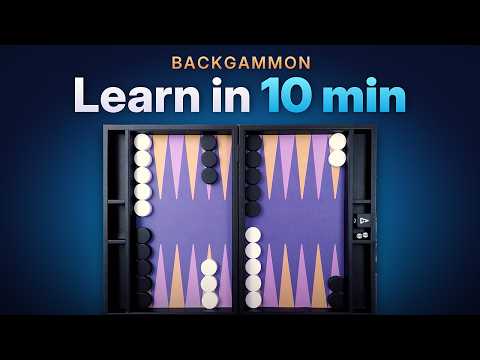 ▶
Watch: How to Play Backgammon (Backgammon Galaxy)
Strategy 1: Learn the board and the setup before your first match
Backgammon is a race, and the race starts from the same layout every time. The board has 24 narrow triangles called points, split into four quadrants of six. Each player has 15 checkers, and both sides start in the same mirrored layout: 2 checkers on your 24-point, 5 on your 13-point (the midpoint), 3 on your 8-point and 5 on your 6-point. You move your checkers around the board toward your own home board — the six points numbered 1 to 6 on your side — and the first player to bear all 15 checkers off wins. To decide who moves first, each player rolls one die; the higher roll goes first and plays both numbers rolled. After that you take turns rolling two dice, and each die is a separate move: you can move one checker by one die and another by the other, or move a single checker by both, as long as every landing point is open. Roll doubles and you get four moves of that number instead of two. Learn this setup by heart before you play for coins, because every decision in the game — what to hit, what to build, when to run — only makes sense once you know where the checkers start and which direction they travel.
Strategy 2: Make points and stop leaving blots lying around
The single most important habit in backgammon is making points. Two or more of your checkers on a point make it yours, and your opponent cannot land there. A single checker alone on a point is called a blot, and if your opponent lands on it, that checker is hit and sent to the bar in the middle of the board — and it must re-enter into your opponent's home board before you can move anything else. So the basic rule of every move is: land in pairs where you can, and never leave a blot within reach of an opponent's checker unless you have a reason. The guides agree on the priorities: build your home board first, because a strong home board makes every hit hurt more; make an anchor — a point deep in your opponent's home board, usually the 5-point or the bar-point — so you always have somewhere safe to land; and build a prime, a run of four to six made points in a row, which walls your opponent's checkers in behind it. The opposite mistake is scattering single checkers across the board to chase a quick run home. That feels fast, but every blot is a free hit for your opponent, and a hit checker on the bar can cost you the whole game.
Strategy 3: Use the doubling cube — carefully
The doubling cube is the part of backgammon that turns a quiet race into a gamble, and Lord of the Board includes it: the cube is available at higher levels, and player reviews note the cube button sits right next to the Roll Dice button, so it is easy to tap by accident — be careful where your thumb lands. The cube is marked 2, 4, 8, 16, 32 and 64. Before rolling, a player who feels ahead can offer to double the stakes; the opponent must accept, taking control of the cube for any future double, or decline, conceding the game at the current stake. The tutorial video above covers the cube at 8:26, and the rule of thumb from the guides is simple: double when you are clearly ahead but the game is not yet decided, and take a double when you still have a realistic chance to win — roughly a one-in-four chance or better. Never double just because you rolled well once, and never accept a double out of pride when your position is collapsing. In this app the stakes are coins, and a gammon doubles the stake while a backgammon triples it, so a careless double can cost you several matches' worth of winnings in a single game. If you are new, play your first matches at the lowest stakes and leave the cube alone until the rest of the game feels automatic.
Strategy 4: Count pips and play the race, not the fight
Once the checkers stop hitting each other and both sides are running home, backgammon becomes a pure race — and the race is decided by the pip count. Your pip count is the total number of pips you still need to move to bring all your checkers home and bear them off; both players start at 167. The app shows the pip counts on the bars during a match, so use them: if you are ahead in the race, keep it simple, avoid risky hits and just run your checkers home. If you are behind, that is when you need to fight — hit a blot, build a prime, or hold an anchor and wait for a shot. The other half of the endgame is bearing off itself. Once all 15 of your checkers are in your home board, you can start removing them: a roll of a given number bears off a checker from the matching point, and if there is no checker on that exact point, a higher roll can bear off from your highest occupied point instead. The guides' advice for bearing off is to clear the high points first and avoid leaving gaps, because a single checker stranded on your 6-point can take several rolls to bring home while your opponent finishes. Win the race and you win the match; lose track of the pip count and you will double yourself into a loss you never saw coming.
Strategy 5: Treat your coins like a bankroll, not a slot machine
Here is where our Dinsun critic's warning matters most. Lord of the Board is free, but everything in it runs on coins: table stakes, tournament entries and the boards and dice you unlock. The developer's own support pages say you earn coins by winning matches, by daily bonuses and by limited-time events and quests — and you can also buy them. So the free route is real, but it is slow, and the app's pop-ups will keep offering you coin packs. Three rules keep the free coins lasting. First, play at tables that match your balance: the support pages say higher-stakes tables mean bigger wins but also bigger losses, so stay at the rookie tables until you are winning more than you lose. Second, collect the free bonuses — the welcome bonus, the daily bonus and the event rewards — before you spend anything; they are the app's own way of refilling your bankroll. Third, never chase a loss by jumping to a bigger table: a gammon at high stakes can wipe out a week's worth of daily bonuses in one game. And remember the fine print from the App Store listing: these are virtual coins with no cash value, and winning here does not mean you would win at real-money backgammon. Play it as a board game, not as a casino.
Walkthrough 1: Your first match — welcome bonus and rookie tables
Open the app and take the free welcome bonus the App Store listing promises — it is your starting bankroll, so do not spend it on a cosmetic board before you have played a match. The listing also says "rookie bets will get you started immediately", so head for the lowest-stakes Quick Play table, not a tournament and not a high-stakes room. Your first match is against a real opponent matched by table stake and sometimes by level, and a typical match runs a few minutes. Before you roll, look at the board and find your home board, your midpoint and your bar — the app handles the rules for you, but it will not tell you which move is good. Play this first match slowly: tap a checker to move it by the higher die, or drag it to any legal point, and watch how the app highlights the legal moves. If you win, you collect the pot and both players earn XP toward the next level; if you lose, you lose only the small stake. Play three or four of these low-stakes matches before you even look at the tournament tab.
Walkthrough 2: Your first full game, move by move
Every game opens the same way. Each side rolls one die to decide who goes first; the higher roll plays both numbers. Suppose you roll a 6 and a 4 on your first turn. The classic opening from the guides is to bring two checkers down from the midpoint: one to your 7-point with the 6, one to your 9-point with the 4 — two made points in your outer board, no blot left behind. From there, the pattern of a game is the same every time: roll, look at both dice, and ask the two questions from Strategy 2 — can I make a point, and am I leaving a blot? If you roll doubles, you get four moves: a 3-3 lets you move 3 pips four times, which is often enough to build two points in one turn. When your opponent leaves a blot in range, hit it: their checker goes to the bar and they lose their next moves re-entering it, while you gain a tempo. When one of your checkers is hit, re-entering comes first — you cannot move anything else until that checker is back on the board, and you re-enter into your opponent's home board on an open point matching one of your dice. If every point is blocked, you lose the turn. That is the whole game in miniature: make points, hit blots, re-enter quickly, and keep your checkers moving toward home.
Walkthrough 3: The middle game — primes, anchors and hitting
By the middle of a match the board has split into two stories: one side is building and the other is running. Your job in the middle game is to decide which story you are in. If your pip count is ahead, keep building: extend your prime point by point — five or six made points in a row is a wall your opponent's back checkers cannot pass — and keep your home board strong so any hit you land really hurts. If your pip count is behind, hold an anchor in your opponent's home board and wait: an anchored checker can hit your opponent's blots as they try to bear off, and it gives you a way back into the game. The mistake to avoid here is the one the gameplay video above shows beginners making: playing recklessly, leaving blots everywhere to chase a fast run home, and getting hit three times in a row. A prime you build slowly wins more games than a sprint that leaves your checkers on the bar. And if the cube appears at your level, remember Strategy 3 — the middle game, when one side is clearly ahead but the game is not over, is exactly when doubles get offered, so check the pip counts before you tap anything near that button.
Walkthrough 4: Bearing off and winning — the race and the gammon
Once all 15 of your checkers are in your home board, the game changes: you stop moving and start bearing off. A roll of 6 bears off a checker from your 6-point, a roll of 1 from your 1-point, and a roll higher than your highest occupied point bears off from that highest point instead. The guides' rule here is to bear off from the highest points first and keep your checkers spread evenly, so you are never stuck waiting for one exact number while your opponent finishes. Watch the score as well as the board: a standard win pays the stake, but if your opponent has not borne off a single checker when you finish, it is a gammon worth double — and if they still have a checker on the bar or in your home board, it is a backgammon worth triple. That is why the endgame matters so much in this app: a gammon at a high-stakes table can double your pot, and a backgammon against you can triple your loss. If you are winning the race by a wide margin, play safe and bear off cleanly; if you are losing it, your only hope is a hit — leave an anchor, wait for a blot, and send one of their checkers to the bar before they can finish.
Walkthrough 5: Tournaments, levelling up and the long game
When low-stakes Quick Play feels routine, the app's progression opens up. Live tournaments run on a schedule and pay out bigger coin prizes to the top of the leaderboard — the App Store listing calls the tournament rush "simply unbeatable", and our Dinsun critic agrees the tournament structures are one of the app's best features. Enter a tournament only with coins you can afford to lose, and treat your first few as practice: the opponents are stronger and the stakes are higher than Quick Play. Outside tournaments, the long game is levelling up: every match earns XP, levelling unlocks new boards and dice, and your player statistics profile tracks your wins, your win rate and your best streaks. There is also a practice mode against the AI, which player reviews say offers beginner, medium and expert levels — use it to try a new idea, like building a prime instead of running, without risking coins. There is no final level to beat: the closest thing Lord of the Board has to finishing it is climbing the leaderboard and holding your own at the high-stakes tables. A good goal is to win more than you lose at your current table for a week, then move up one stake level — and if you start losing more than you win, drop straight back down.
Stuck? A short checklist before you look anything up
First, if you keep losing coins fast, check your table: are you playing at stakes your balance can survive, or did you jump up after a win? Drop back to the rookie tables, not up. Second, if you keep getting hit, count your blots — the usual culprit is leaving single checkers in range of your opponent's dice; make points instead. Third, if a match feels unwinnable, check the pip counts on the bars: you may be behind in a race you are still trying to fight, when the right move is to run home and bear off. Fourth, if you doubled by accident, remember the cube button sits next to Roll Dice — App Store reviewers warn about this — so slow down and look before you tap. Fifth, if you are out of coins, the developer's support pages say free coins come from winning matches, daily bonuses and events — collect those before buying a pack. And if a written step is hard to picture, watch the tutorial video above — it shows the setup, the hitting, the bearing off and the doubling cube on a real board.
Have you climbed the leaderboard in Backgammon - Lord of the Board, or are you stuck on a match the dice keep ruining? Tell us in the comments — and if you want the next walkthrough, tell us which game from our iOS list you want covered next.