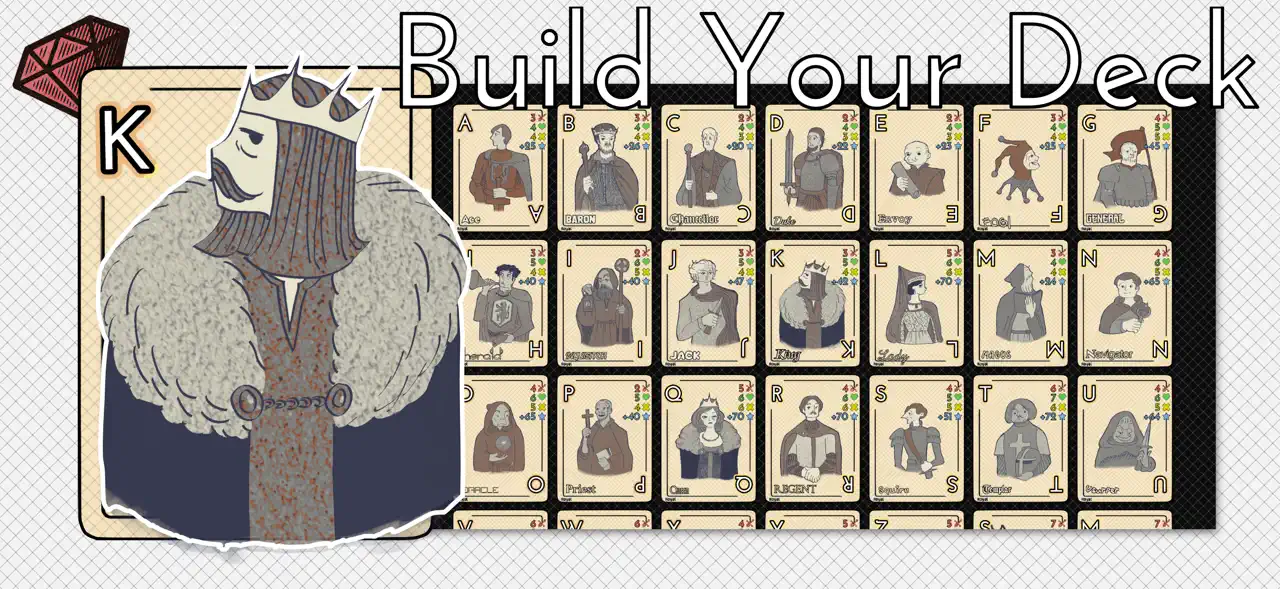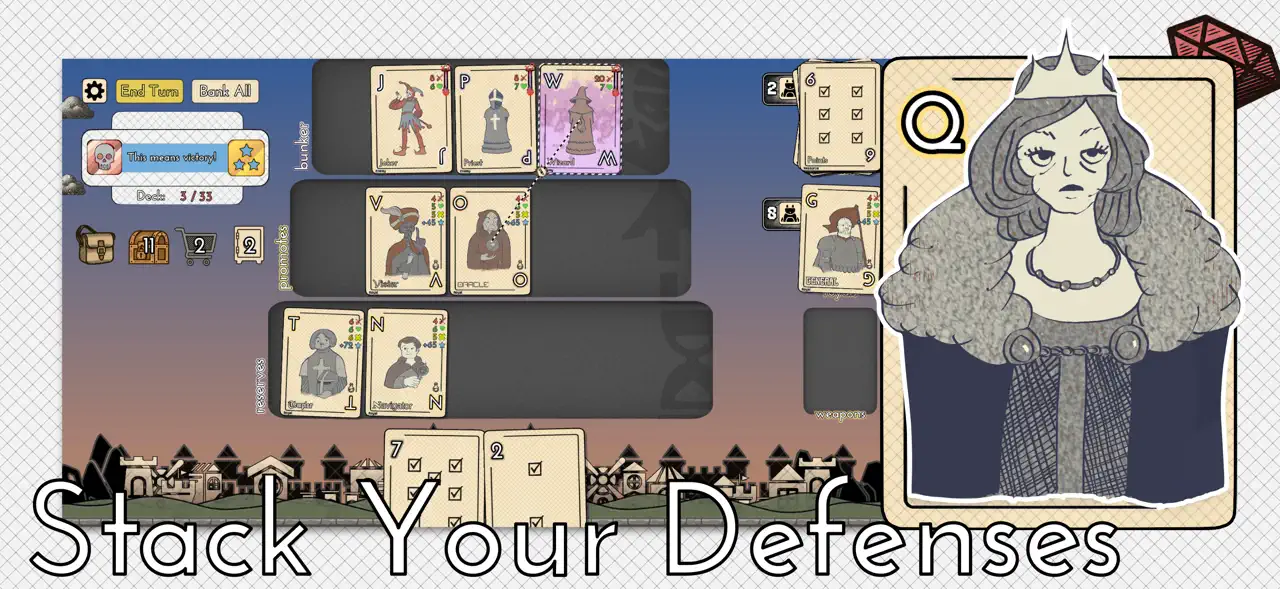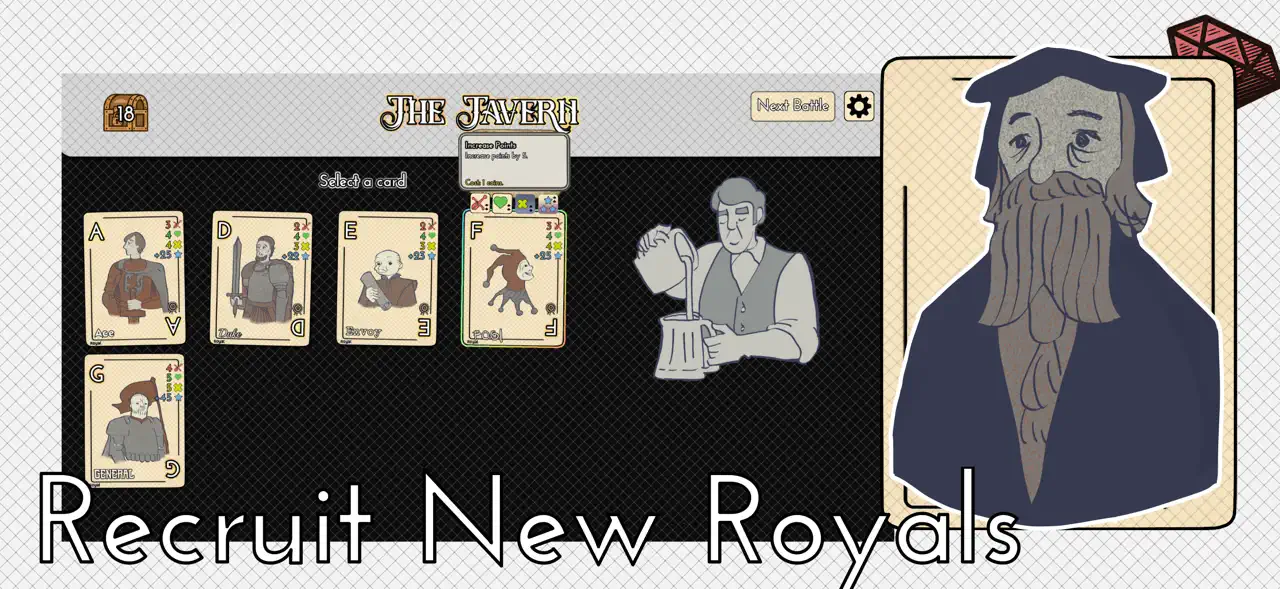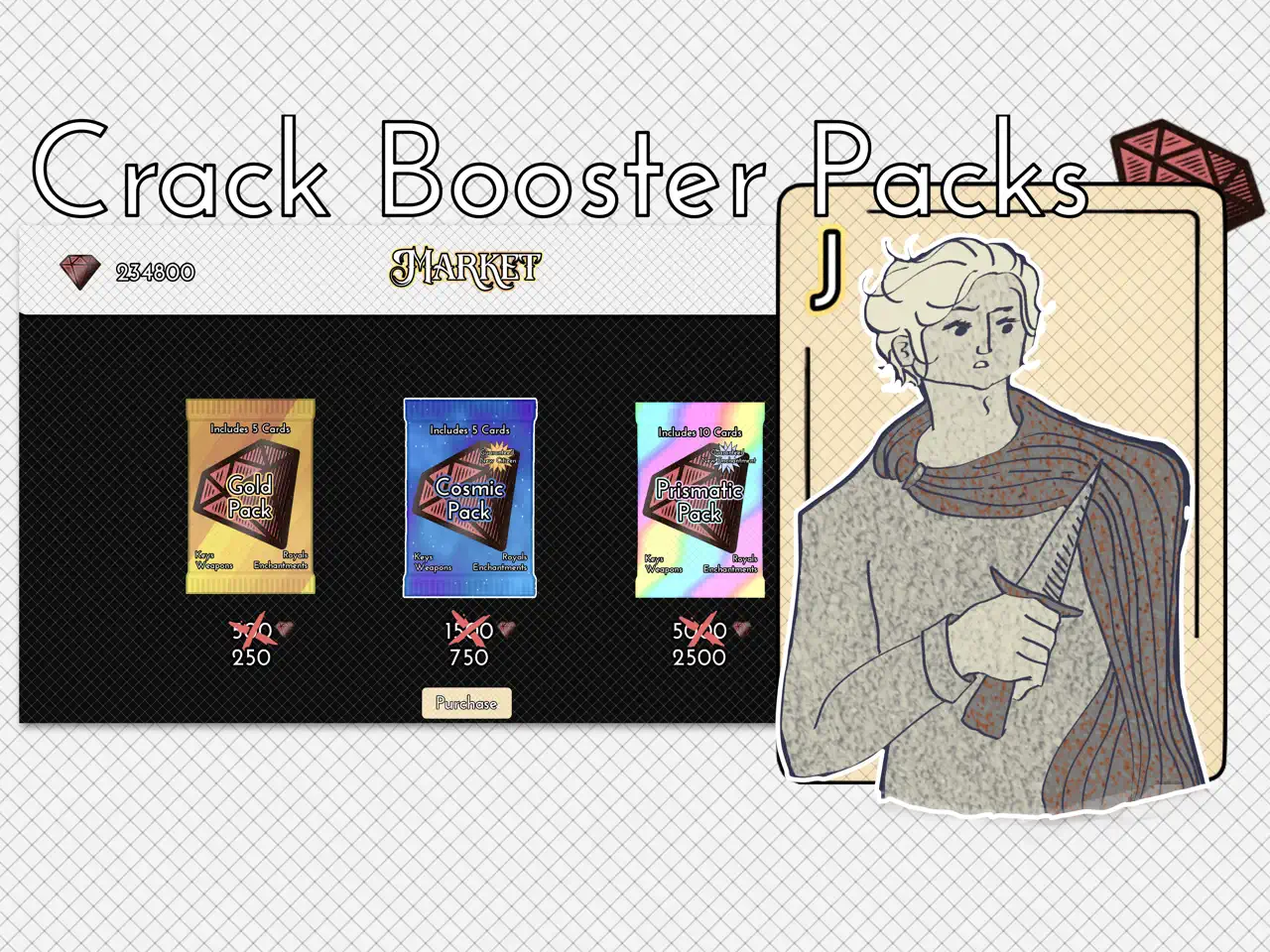
Luxuriant starts from a charming question: what if the royal cards in a deck of playing cards had a kingdom of their own? That idea gives it more personality than most deck-builders, which usually settle for a generic dungeon or tower. The woodcut-and-storybook look suits the premise well, and it makes the game feel more like a handmade object than a template.
The design has a clever core. Your deck is built from Royals, Citizens, Weapons and Resources, and every battle chips away at it. That wear-and-tear mechanic changes how you think. You are not only trying to win each fight, you are trying to win it cheaply enough that your deck can survive the next one. Jewels let you recruit new Citizens and Royals, so the run becomes a constant balance between spending and preserving. When it clicks, it creates the kind of tense, thoughtful decisions that make roguelike deck-builders so addictive.
The long-term structure also works. Earning Influence, moving through evolving levels, and unlocking new cards for future runs gives you a reason to keep trying after a failed attempt. That is exactly what the genre needs, since players will naturally lose a lot while learning how the card types work together.
The weak spot appears to be polish. The game is from a small indie team, and early player feedback has pointed to the interface as an area that needs work. In a card game where reading text and understanding the board are everything, a cluttered or awkward UI can drag down an otherwise smart design, and this will matter even more on a small phone screen. It also has to compete against genre giants with years of refinement.
Still, Luxuriant is a creative and thoughtful take on a crowded genre, and the playing-card kingdom hook is memorable. If you like deck-builders and don't mind some rough edges from a small studio, it is worth a look. I'd expect it to improve noticeably with updates, and fans of strategy card games should keep an eye on it.
Let me be upfront about where I'm coming from. I have played a lot of roguelike deck-builders, and the genre has a brutal bar: Slay the Spire set the structure, Balatro rewired expectations, and every new entrant is measured against both. Luxuriant is not trying to out-clever those games, and I respect that. What it offers instead is a warmer, more tactile take: you manage Royals, Citizens, Weapons and Resources, spend Jewels to recruit more of your court, and watch your deck get chipped away battle by battle as invaders press on your districts. That attrition idea is the part I find genuinely interesting, because it forces you to treat your deck as a resource rather than a fixed toolbox.
The content list is respectable for a small studio. Quests, five bosses with unique transformations, secret rare cards, booster packs, forging and awakening shops, three save slots, even slot machines and boon cards. It is also hand-drawn, family-friendly and has a day/night cycle and weather, which gives it more personality than most deck-builders. My caution is simple: a long feature list is not the same as depth. Slot machines and booster packs can be a fun diversion or they can be filler, and I would need real hours to tell which. The Steam release dates to March 2026, but the iOS version only appeared on November 20, so there is very little public feedback about how it plays on a phone, and I am not going to pretend there is.
Turn-based card combat is a natural fit for touch, which is the best thing I can say about the platform choice. Short runs, deliberate decisions, nothing that punishes a clumsy thumb. The risk is in the details: tooltips, card readability on a small screen, and whether the UI copes with that many card types. I will also say plainly that story and character are not the point here. The fantasy kingdom is a framing device, not a narrative, and I would not buy this expecting anything else.
My verdict is measured. It is a solid, charming indie that I would happily recommend to someone who loves deck-builders and wants something a little more relaxed. It is not a new benchmark, and I would not pay launch price on faith. Try it when the price drops or after a few more weeks of player feedback, and see whether the strategy holds up past the first few runs.
Performance: Turn-based combat should be light on hardware. The mobile version is brand new as of November 20, 2026, so watch card readability on small screens and early bug reports.
Buy if: You love roguelike deck-builders, enjoy managing a collection of cards and upgrades, and want something calmer and more charming than the genre's usual brutal difficulty.
Skip if: You want a deep, tightly balanced card game on the level of Slay the Spire or Balatro, or you care about story and characters.
Available on: iPhone, iPad
Version 2.0.1Sat Nov 07 2026
corrected store images
Requires iOS 16.0 or later. Compatible with iPhone, iPad, and iPod touch.Build a deck. Defend a kingdom. Make every card count.
Luxuriant is a single-player fantasy roguelike deck-builder. Assemble Royals, Citizens, Weapons, and Resources, then battle invaders across your kingdom’s districts in turn-based combat. Earn Jewels, recruit allies, promote Royals, and choose your weapons carefully as each battle reshapes your deck.
DISCOVER YOUR NEXT STRATEGY
• 25+ Royal cards and 25+ Citizen cards with unique abilities
• 20+ Weapon cards and 35+ Enemy cards
• 8 card suits and 70+ unlockable cards
• 25+ levels and 5 bosses with unique transformations
• 25+ status effects and 10+ enemy effects
• 35+ quests with rewards
• Billions of seeds for fresh runs
GROW YOUR COLLECTION
Discover rare cards, open booster packs, and visit upgrade shops to forge cards, awaken weapons, and enchant Royals. Build new combinations as you unlock more possibilities for future runs.
A KINGDOM WITH ATMOSPHERE
Dynamic weather, a day/night cycle, and layered music accompany your journey. Multiple tutorials help you learn the rules, while three save slots let you keep separate adventures.


Luxuriant is a fantasy card-driven roguelike deck-builder from indie developer Goblin Runt Games. It asks what would happen if the Royal playing cards had a kingdom to defend. You assemble and manage a deck made of Royals, Citizens, Weapons and Resources, then fight turn-based battles through the Districts of your kingdom as they are actively invaded. Every battle chips away at your deck, while you store up Jewels to recruit more Citizens and Royals. You earn Influence, advance through evolving levels, and unlock new cards for future runs. The art style resembles medieval woodcuts and hand-drawn storybook illustrations. The game launched on Steam in March 2026.
Fantasy card-driven roguelike deck-builder
Deck made of Royals, Citizens, Weapons and Resources
Turn-based combat against invading Enemies
Battles chip away at your deck, adding long-term strategy
Collect Jewels to recruit more Citizens and Royals
Earn Influence, progress through evolving levels and unlock new cards for future runs
Medieval woodcut and storybook-inspired art
The original PC release from GoblinRunt Games, with the full description, tags and demo.
Developer updates and hotfix notes for the PC version.
Shows Luxuriant appearing as a new App Store listing on November 20, 2026, described as a single-player fantasy deck-builder roguelike about protecting a kingdom.
Infinity Nikki 2.0 deserves the heat that’s coming its way escapistmagazine.com
escapistmagazine.com - Fri Nov 28 2025
Anya Taylor-Joy’s ‘The Gorge’ Promo Tour Wardrobe Features Luxuriant Looks From McQueen and Celine Yahoo
Yahoo - Wed Feb 05 2025
Eden Park - from swamp to sports ground NZ History
NZ History - Wed Nov 20 2024
Forza Motorsport review – an icy, luxuriant driving sim that honours raw V8 power The Guardian
The Guardian - Fri Oct 13 2023
Here's Genshin Impact's 3.0 update release date Eurogamer.net
Eurogamer.net - Sun Aug 14 2022
Getting Started with Naraka: Bladepoint, the Mythical Action Battle Royale XBOX Wire
XBOX Wire - Thu Jun 23 2022
Peter Drake joins Luxuriant Flowing Hair Club for Scientists (LFHfC) Improbable Research
Improbable Research - Tue Nov 02 2021
How To Get Sakura Blooms Genshin Impact Gosunoob.com
Gosunoob.com - Wed Jul 21 2021
The Fiver | Luxuriant Kajagoogoo wigs and proportionate levels of outrage The Guardian
The Guardian - Thu Apr 29 2021
The Fiver | The long and wide shadow cast by Toni Polster’s luxuriant mane The Guardian
The Guardian - Mon Jan 04 2021
Battles are turn-based and driven by the cards you draw. You choose which Royals, Citizens and Weapons to play against invading Enemies, and planning your turns matters more than reacting quickly.
The central twist is that battles chip away at your deck. That keeps each choice meaningful, because you have to decide whether to push ahead or play safe, and a strong run depends on long-term management.
You fight through the Districts of your kingdom, which are being actively invaded. The setting gives the runs a clear goal and story, and the evolving levels change how each District feels.
The art resembles medieval woodcuts and hand-drawn storybooks, which gives the card game a warm, old-fashioned feel and supports the playing-card kingdom idea.
It is a fantasy roguelike deck-builder with turn-based combat. You build a deck of Royals, Citizens, Weapons and Resources to defend a kingdom from invaders.
The game asks what would happen if the Royal playing cards had a kingdom. It extends the Jack, Queen and King idea into a full fantasy world that must be defended.
No. Each battle chips away at your deck, and you collect Jewels to recruit more Citizens and Royals as you go.
You earn Influence and progress through the evolving levels, which unlocks new cards for future runs.
It was developed by the indie studio Goblin Runt Games and released on Steam in March 2026.
Now, this is a real game. No fluff, no microtransaction nonsense, just pure mechanical brilliance. Slay the Spire is built on a foundation of iron-clad logic. Every card you add to your deck matters, and every relic you pass up could be your undoing. It's a game about consequence, something many modern mobile titles are afraid to touch. The balance between risk and reward—whether to elite-hunt for relics or play it safe at a campfire—is perfectly pitched. My only real gripe here is the port itself. While the gameplay is untarnished, the UI on a standard phone screen feels like it was designed for someone with much smaller fingers than mine. Selecting the right card in a full hand can be finicky, and the text can be a strain. However, once you’re in the flow, these issues fade. It’s a conservative design in the best way: it trusts the player's intelligence. It’s hard, it’s fair, and it’s arguably the best strategic use of your time on the platform.
I don't say this often: this is a game actually designed by people who like games. Balatro takes the familiar rules of poker—something I’ve played at real tables for twenty years—and twists them into a math-driven roguelike that is dangerously addictive. It doesn't use 'energy' to stop you from playing; it doesn't have a battle pass. It just has depth. The genius is in the Jokers. Every run feels like a fresh puzzle to solve. One minute you're building a deck around flushes, the next you're banking everything on a single high card. It’s tight, it’s polished, and the CRT-style aesthetic actually feels purposeful rather than just lazy 'retro' bait. It's the most innovative card game since 'Slay the Spire', and it actually treats the player like an adult. This is what mobile gaming should be.
Dinsun here. I don't give out high scores often, and 78 is high for me. Monster Train is one of the few deck-builders that actually understands how to iterate on the Slay the Spire formula without just copying it. The three-floor mechanic is brilliant, adding a layer of spatial management that forces you to think three turns ahead. Most mobile games are brain-dead; this one expects you to actually pay attention. Now, it’s not perfect. The UI on smaller screens is cramped. If you aren't playing on a Pro Max or an iPad, you're going to be squinting at card text. The visual style is a bit 'busy' for my taste—lots of glowy effects that feel a bit juvenile—but the underlying math is rock solid. It’s a proper game that rewards skill over luck, which is rare in this market. If you can stomach the dark, cartoonish aesthetic, there is a real challenge here.
Deck-building roguelikes have become a crowded genre ever since Slay the Spire proved how brilliant the formula could be, but finding titles that execute the concept well on mobile is always a treat. Meteorfall: Rustbowl Rumble leans into a quirky post-apocalyptic aesthetic with snappy mechanics, clever card synergies, and strategic depth that rewards careful planning. At 40, my schedule doesn't always allow for 50-hour sprawling RPGs, so bite-sized, highly tactical runs like this hit the sweet spot. Every deck choice matters, and bad positioning or sloppy card management will get you punished swiftly. The presentation is colorful and distinct, the humor adds personality without feeling obnoxious, and performance is butter-smooth. While it might not completely reinvent the deck-building wheel, it refines the core formula into a polished mobile-friendly package. If you appreciate smart tactical card battlers that respect your time, this is well worth picking up.
Look, I like Reigns and I like The Witcher. Putting them together is a smart move. The writing here actually captures the dry, cynical tone of Geralt quite well, and seeing familiar faces pop up in the card stack is rewarding for fans. It's the best narrative experience in this list, but that’s not saying much given the competition. It actually forces you to think about the consequences of your 'swipes' rather than just clicking through. However, it's not perfect. The lack of haptic feedback (vibration) on card draws is a bizarre step backward from previous entries. It makes the game feel 'thin.' Also, for a premium partnership, I encountered more bugs than I’d like—stuck cards and occasional crashes. It’s a good game, maybe even a great one once it's patched, but right now it feels like they rushed it out to hit a release window.
I’ll admit, I didn't expect much from a 'claw machine dungeon' game, but Dungeon Clawler actually has some teeth. It takes the deckbuilding trend and injects a physical, skill-based element that makes every turn feel consequential. Instead of just playing a card, you have to physically aim for the gear you've added to the machine. It’s frustrating in a way that feels intentional—much like a real claw machine—but the upgrades actually matter. The art style is clean and the loop is addictive enough to keep me coming back for 'one more run,' a phrase I don't use lightly. It’s not perfect; some of the RNG can feel particularly cruel when the physics don't go your way, and the variety of enemies could be broader. However, in a sea of clones, this stands out as a genuine attempt at something new. It’s a bit quirky for my conservative tastes, but the execution is solid.
Bean Wizard has charm, I'll give it that. Controlling a little wizard bean firing elemental spells at hordes of monsters makes for an entertaining arcade loop. The spell combination system is the best part—mixing elements to create bouncing fireballs or lightning arcs adds genuine customization to each dungeon crawl. The game suffers from a lack of environmental and enemy variety. After four or five dungeon runs, you've seen most room tilesets and enemy attack patterns. On-screen virtual joystick controls are responsive enough, but precision aiming can get chaotic on a smaller phone screen during heavy boss fights. It's a fun indie effort, just limited in scale.