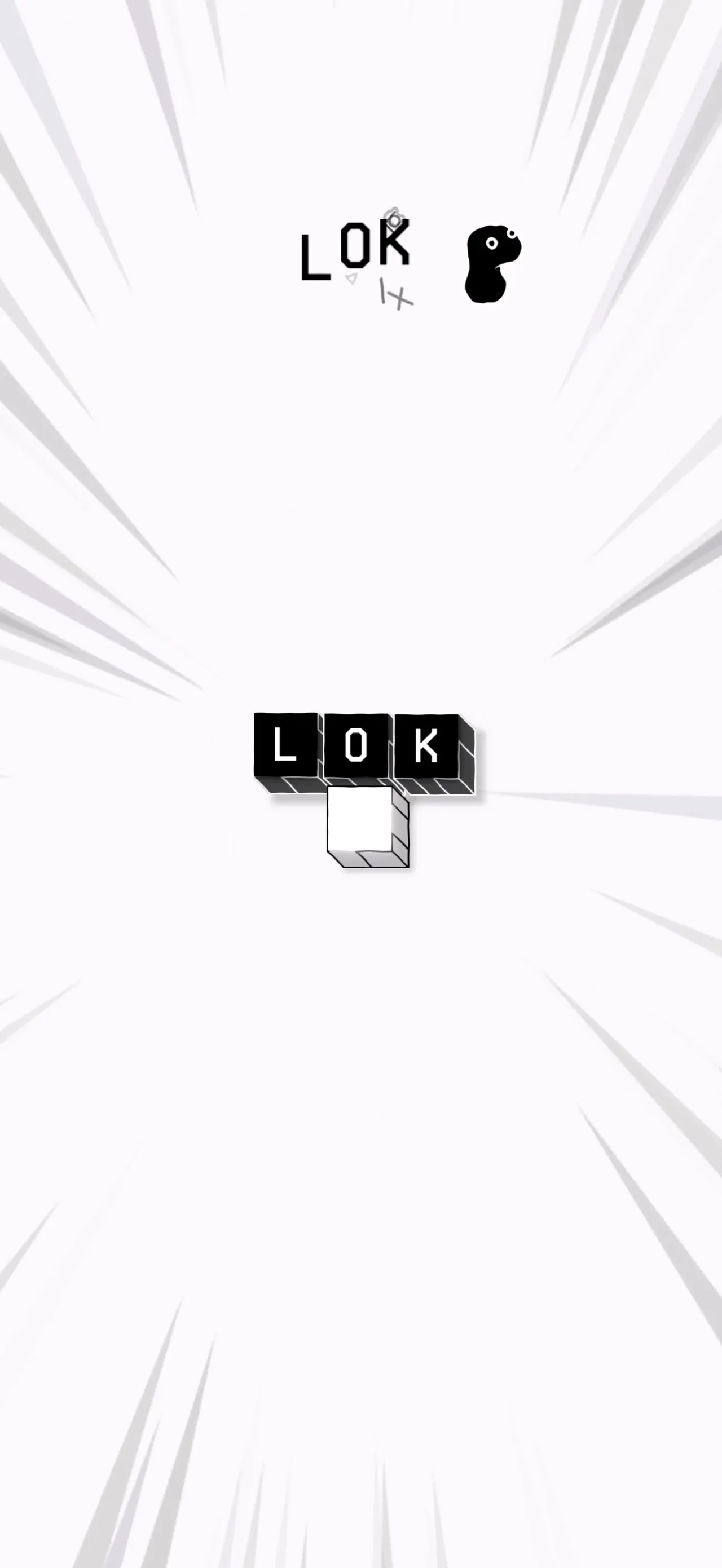
LOK Digital is a breathtakingly intelligent puzzle game that feels like a cross between a linguistic study and a tactical logic challenge. Based on the acclaimed puzzle book 'LOK,' it tasks you with learning an artificial language not through vocabulary lists, but through pure deduction. You have to figure out the 'grammar' of symbols on a grid by observing how they interact with each other when you connect them. It’s an 'Aha!' moment factory.
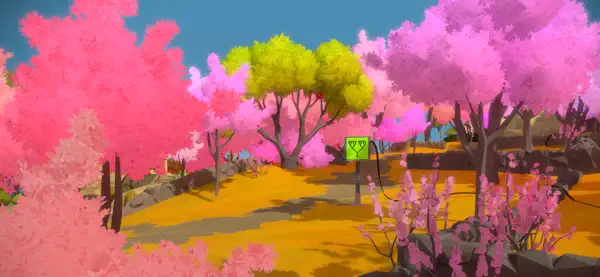
The minimalist presentation is perfect, focusing your entire attention on the logic of the board. There are no tutorials, no hand-holding—just pure intellectual discovery. What I love most is how the game respects the player's intelligence; it allows you to fail, to experiment, and to slowly uncover the rules of this mysterious world at your own pace. It is, quite simply, one of the most original and rewarding puzzle games currently available on mobile. If you enjoy games like 'The Witness' or 'Baba Is You,' LOK Digital is an absolute masterpiece.
Every once in a while, something comes along that actually makes me stop and pay attention. LOK is that game. I’ve played word games for decades, and I’ve never seen anything like this. You aren't just finding words; the words are the mechanics. Spelling 'LOK' might clear tiles, while other words change how the grid behaves. It’s brilliant.
The difficulty curve is perfect. It starts simple and then hits you with these 'aha!' moments that make you feel like a genius. There are no ads, no gacha, no nonsense. Just pure, high-level game design. The minimalist aesthetic and the sound design are top-notch. It’s $7, and it’s worth every penny. This is what mobile gaming should be—innovative, respectful, and genuinely challenging. If you only buy one game this year, make it this one. I don't say that often.
Performance: Perfect performance; highly polished.
Buy if: You love puzzles that make you rethink how games work.
Skip if: You want a mindless game to play while watching TV.
Available on: iPhone, iPad, iPod
Version 1.0.35Tue Apr 22 2025
Fixes for better offline support
Requires iOS 13.0 or later. Compatible with iPhone, iPad, and iPod touch.Start the game for free - only one transaction to unlock the full game!
DISCOVER A CRYPTIC LANGUAGE OF WORLD-CHANGING WORDS
Learn the rules as you go and uncover how each new word has its own special ability to change the world around you in deep and surprising ways. Expand your vocabulary through 15 distinct worlds, each one exploring a new mechanic and completely shaking up the way you solve puzzles.
MASTER THEIR MIND-BENDING EFFECTS
With approachable mechanics and mind-bending gameplay, LOK Digital invites you to return every day for new procedurally generated puzzles showcasing the breadth and depth of mechanics.
HELP THE LOK CREATURES THRIVE
Bring the LOK creatures to life by spelling words that shape their world. They can only live on blackened tiles, so by solving puzzles you're expanding their horizons and helping their civilization thrive.
Features:
Intuitive mechanics and many magical words to find and learn
Elegant, hand-drawn art style and meditative, entrancing soundtrack
Learn the nuances of the LOK language across the 150+ puzzle campaign
Demonstrate your mastery of the mechanics in the expertly crafted daily puzzle mode and compete on the leaderboards
Based on the critically acclaimed puzzle book, LOK
Published by the award-winning puzzle experts, Draknek & Friends, the team behind A Monster’s Expedition, Cosmic Express, Bonfire Peaks, and more


LOK Digital is the official digital adaptation of the world-renowned puzzle book 'LOK.' Embark on a journey of linguistic deduction where you must learn the rules of an artificial language to clear the grid. Connect 'words' and symbols, observe their effects on surrounding tiles, and master a complex evolving grammar. With over 100 hand-designed puzzles and a stunning minimalist aesthetic, LOK Digital is a deeply rewarding intellectual challenge that encourages creative thinking and experimentation.
Over 100 handcrafted, non-linear puzzles
Innovative 'Learn by Doing' gameplay loop
Stunning and clean minimalist visual design
Deep, rewarding logic-based challenge
Atmospheric and meditative soundtrack
As you move through the chapters, the rules combine. A word that was 'destructive' in Chapter 1 might be 'creative' when placed next to a new symbol in Chapter 2. Keep a mental or physical notebook of these interactions to solve the complex endgame grids.
No, it's a logic puzzle where the 'words' are symbols with specific mechanical rules that you must discover.
I don't hand out scores like this often. Baba Is You is a stroke of genius. It forces you to unlearn everything you know about gaming logic. Most puzzles have a solution you need to find; here, you have to build the solution by rewriting the laws of physics. It’s incredibly difficult, and it will make you feel like an idiot before it makes you feel like a god. The port is perfect, the touch controls work fine, and the minimalist art is iconic. If you have any interest in logic or game design, this isn't just a recommendation—it’s mandatory. Dinsun is impressed, which rarely happens.
The Witness is probably the most intelligent game on the App Store, though it’s certainly not for everyone. It doesn't hold your hand; it doesn't even tell you how to play. It expects you to observe, learn, and deduce. Every puzzle is a lesson in a new language, and the way the game builds on its own complexity is nothing short of brilliant. That said, it can be incredibly frustrating. If you get stuck, you’re just... stuck. The island is beautiful but cold and clinical. It’s a purely intellectual exercise. On mobile, the touch controls are surprisingly good, but the game is very demanding on hardware. It’s a 'hard' game not because of reflexes, but because it refuses to compromise on its vision. I respect that, even if I wanted to throw my iPad across the room a few times.
Puzzmo stands out in a mobile landscape dominated by trashy ad-filled clones. The game mechanics across its daily offerings—ranging from inventive crosswords to spatial tile sorting—are tight, clever, and refined. It has a mature, editorial feel that respects your time. My only reservation is the subscription-leaning model for full historical access and the reality that not every daily puzzle type lands with equal brilliance. Still, as a daily ritual, it is easily the most respectable puzzle app on this list.
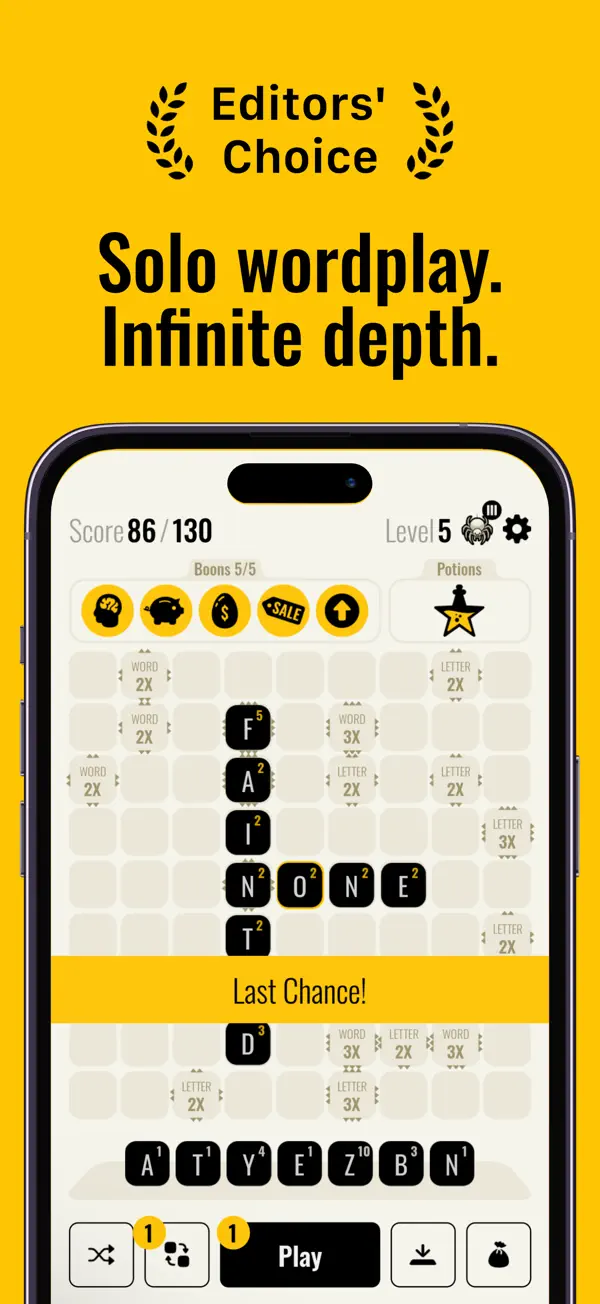
Finally, something that isn't a direct clone of something else. Rogue Words takes the 'Scrabble' formula and injects it with a healthy dose of roguelike DNA. It’s an odd pairing, but it works surprisingly well. The tension of trying to find a high-scoring word while being on the verge of death in a run is genuine. It’s more than just a spelling test; it’s about managing your 'letters' as a resource and choosing the right time to use your power-ups. The visuals are a bit minimalist—functional, but not impressive—and the UI can feel a little cluttered on smaller screens. My biggest gripe is the dictionary; it feels a bit inconsistent, rejecting words I know to be valid while accepting obscure slang. However, the core loop is satisfying. It respects the player's intelligence more than the average mobile game, and the permadeath keeps the stakes high. It's not perfect, but it's a step in the right direction for a platform that usually rewards mindless tapping over actual thought.
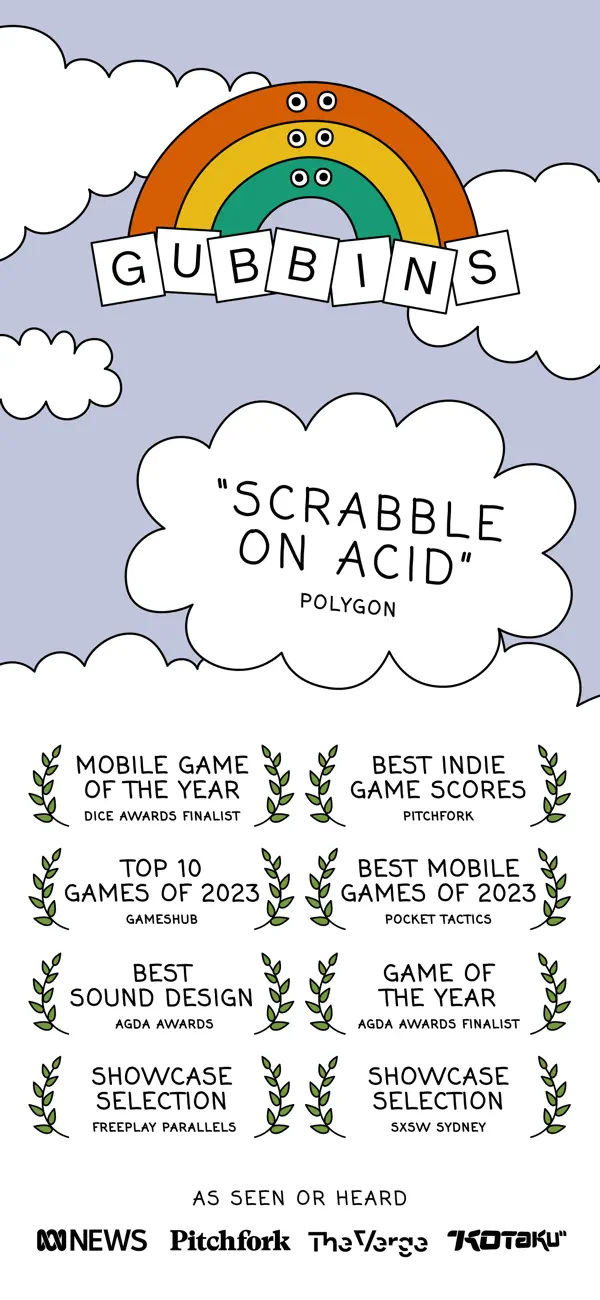
I’ll admit it—Gubbins caught me off guard. Usually, I hate these 'whimsical' indie titles because they use style to hide a lack of substance. But Gubbins actually has a brain. The word-building is solid, and the way the different Gubbins affect the board adds a layer of chaos that most word games are too afraid to touch. It feels like someone took Scrabble and threw it into a blender with a bunch of underground comics from the 70s. It’s a premium-feeling experience, even though it’s free-to-play (with a very fair 'pay once to unlock' model). It’s clever, it’s stylish, and it actually made me enjoy a word game for the first time in years. High marks for originality.
I hesitate to even call POOLS a 'game' in the traditional sense, but I can't deny its effectiveness. There are no objectives, no scores, and no enemies. You simply walk. And yet, I haven't felt this much genuine tension in a title in years. It taps into something primal—the fear of the infinite, the 'offness' of a space that should be crowded but is utterly empty. The tiling, the lighting, and the echoing splash of your own footsteps create an environment that is both beautiful and deeply unwelcoming. It’s a 'walking simulator' in the purest form, but it understands its niche perfectly. The lack of a HUD or any gamified elements makes the immersion absolute. My only real criticism is the price-to-content ratio for some; at six chapters, you can finish it in an afternoon. But for those of us who value a specific, high-quality experience over endless 'content,' POOLS is a standout. It’s an art piece you can walk through, and it’s one of the few mobile ports that actually feels like it belongs on a high-end display. It’s unsettling, slow, and wonderful.
Infinite Craft isn't really a 'game' in the traditional sense; it's an interface for a Large Language Model. You spend your time dragging words onto other words. In the beginning, it's fascinating—Water and Earth make a Plant, sure. But twenty minutes in, you're combining 'Batman' with 'SpongeBob' to get 'Dark SquarePants' and you realize the 'logic' is just a statistical probability cloud. It’s addictive in a 'just one more try' way, especially when you’re hunting for a First Discovery. However, as an old-school gamer, I find the lack of win conditions or structured progression frustrating. It’s a novelty that wears off once you realize the AI is just hallucinating half the connections. It's a great technical showcase of LLM integration, but as a hobbyist, I need more meat on the bones. It's fun to mess with for an hour, but it’s not something I’ll be talking about in five years.
I’m not a big 'party game' guy, but Wavelength is different. It’s about understanding how other people think, which is a rare and welcome focus. The app is clean and makes it very easy to play with friends who aren't in the same room. It’s a bit light on content if you don't have a dedicated group to play with, but the core mechanic is solid. It doesn't rely on gimmicks—it relies on conversation and subjective reasoning. It’s one of the few social apps I’d actually recommend.