Hungry Hearts Restaurant is more than just a game; it’s a gentle, emotional experience that lingers in your mind long after you've closed the app. In a world of high-stress mobile titles, this is a sanctuary of calm. The loop of cooking authentic Japanese comfort food and serving it to a cast of weary, interesting travelers is deeply therapeutic. The hand-drawn art style and the soft, nostalgic soundtrack perfectly capture the atmosphere of a quiet Tokyo alleyway.
What makes the game truly special is the writing. Each customer’s story unfolds slowly, revealing layers of their lives, regrets, and joys. You aren't just a chef; you're a confidante. As you unlock more recipes and listen to more tales, you start to feel a genuine connection to this small virtual community. It manages to tackle heavy themes of family and loss with a light, hopeful touch. It is a beautiful reminder that a warm meal and a kind ear can change a person's day.
I'll admit, this one almost got to me. It's not a 'game' in the sense of high-octane action or deep strategy, but the atmosphere is undeniable. The Hungry Hearts series has always been about the stories, and this entry is no different. The management loop—cooking, serving, cleaning—is just a framework to deliver these touching vignettes about the customers.
It’s a 'cozy' game, which usually isn't my speed, but the writing is respectful and mature. It doesn't treat you like a child. My only gripe is that the actual gameplay is very shallow. You’re essentially just clicking buttons to progress the text. If you can handle the slow pace, it’s a rewarding experience, but don't go in expecting 'Overcooked.'
Performance: Perfect performance; beautiful hand-drawn art style.
Buy if: You want a slow, emotional story and enjoy Japanese aesthetics.
Skip if: You want a fast-paced management sim that tests your reflexes.
Available on: iPhone, iPad, iPod
Version 1.1.3Sat Oct 11 2025
Fixed some bugs.
Requires iOS 15.0 or later. Compatible with iPhone, iPad, and iPod touch.Every town's got its own local fixture—a homely eatery where everyone is welcome, and everyone knows your name.
Think back, if you would, to your own hometown. What was that one restaurant whose food you'll never forget?
----------------------------------
【Game Summary】
----------------------------------
In Hungry Hearts, help a kindly old lady and her bright-eyed granddaughter run a small family eatery in a quiet corner of not quite modern Japan. This casual restaurant management sim comes jam-packed with story, but you'll also need to manage your finances, upgrade your diner...and cook a whole
lot of tasty food while you're at it!
Here in this unremarkable, sleepy neighborhood in Tokyo, a worn old establishment named "Restaurant Sakura" has been warming hearts and filling bellies for generations.
Recently reopened, it's got a whole new crowd of clientele to serve. They're an odd bunch, sure, and they all seem to have their share of troubles...
But hey, maybe after a few good, tasty meals, they'll open up and share their stories with you, both happy and sad.
Everyone's got that one meal they just can't forget, after all, and a hungry heart needs filling just as much as a hungry belly does.
The long-awaited sequel to the Hungry Heart Diner series is finally here!
This time, we've crossed time and space to bring you a brand-new Hungry Hearts series set in the not quite modern day—Hungry Hearts Restaurant!
Though we've left the dreamy days of the Showa era behind, the taste of those bygone years still lives on. After all, there are those who honor the past, and fight to keep the recipes and flavors of their forefathers alive.
Whether you're a longtime fan of the series or a newcomer to Hungry Hearts, we hope this game brings you a smile, and perhaps some tears as well.
----------------------------------
【Story】
----------------------------------
On a tiny side street in a nameless little neighborhood of not quite modern Tokyo sits a small, unremarkable Japanese eatery.
Above its weather-beaten door an old, faded sign reads:
Restaurant Sakura
Though long since out of vogue, here in Japan a "restaurant" is an eatery specializing in Western-style fusion food. Back before the era of flashy chain restaurants and snazzy bistros, the humble restaurant had its heyday.
Now, well, Restaurant Sakura has seen better days. The taciturn old chef who ran this local fixture passed away the year before last.
His kindly wife was about to close up shop for good when the couple's bright-eyed granddaughter stepped forward.
With a heart full of determination, she swore to keep the place running and ensure her dear grandpa's recipes live on.
Now, the pair are putting a new coat of paint on the place and getting ready for a grand reopening.
Let's take a peek inside, and see how they're doing.
While we're at it, maybe we should lend a hand.
They sure look like they could use the help!
----------------------------------
So, let me guess. The question you're asking yourself right now is "is this game for me"? Well, maybe it is.
-Do you like casual/idle games?
-Do you like games where you run a shop?
-Are you looking for a nice, relaxing story?
-Ever played any of our other games, like Oden Cart, Showa Candy Shop, or The Kids We Were? (If so, thanks a bunch!)
-Are you hungry?*
*Warning: This game is not edible.
Please don't try to eat your phone.
If you answered "Yes!!!!" to any of the above, well, maybe this game's for you. Give it a download and a shot.
It's free, so it won't cost you a dime!





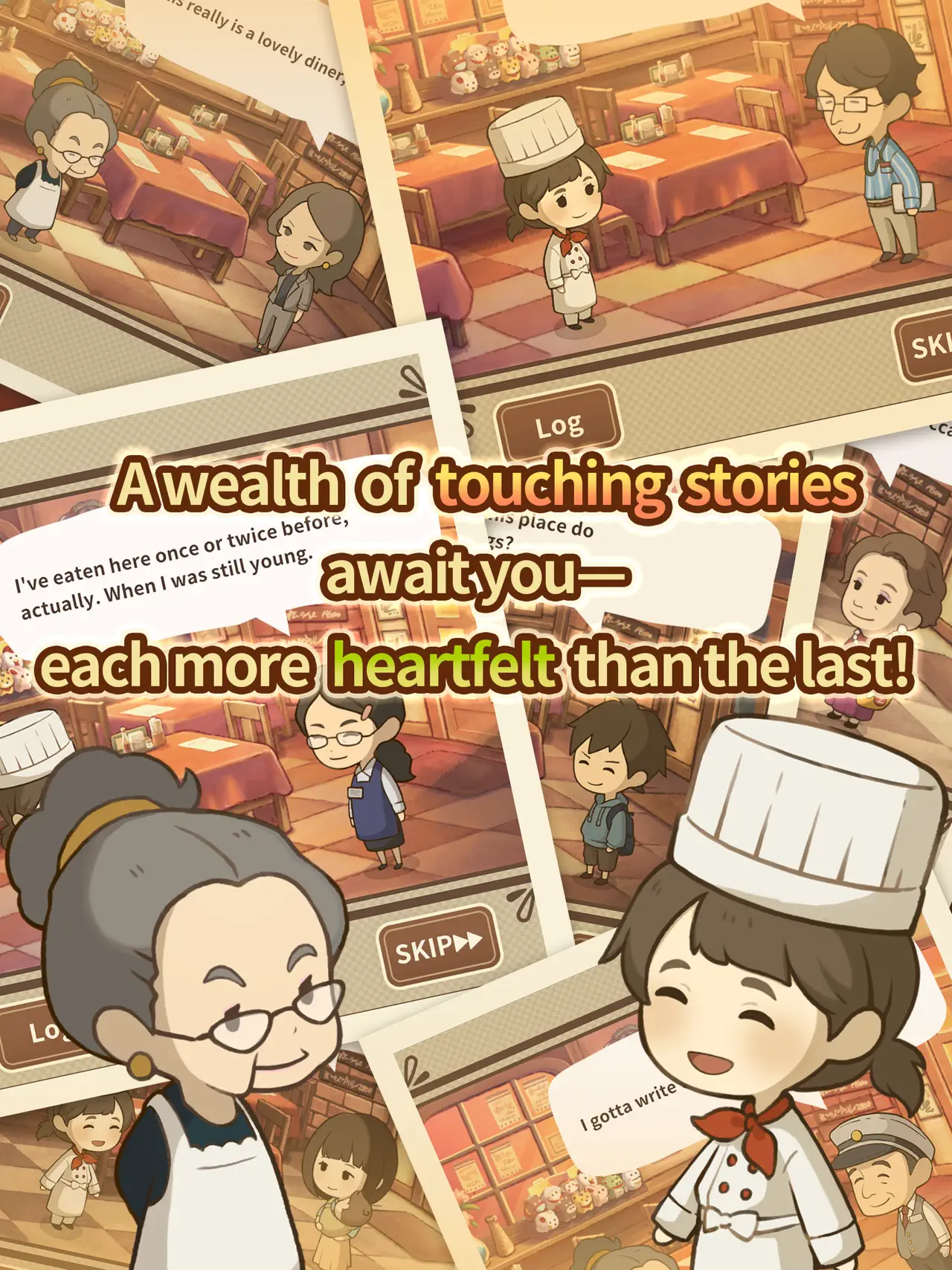
Hungry Hearts Restaurant is a cozy, story-driven management game set in a tiny eatery in 1970s Tokyo. As the grandmotherly owner, you prepare traditional dishes like rice balls, curry, and ramen for a variety of colorful patrons. Each customer has a secret story to share, and as you feed them, they open up about their lives. This is a game about the power of food to bring people together, featuring a beautiful hand-drawn aesthetic and a moving narrative that will warm your heart.
Moving, multi-chapter storylines for every customer
Authentic 1970s Tokyo atmosphere and art
Stress-free gameplay focused on narrative and relaxation
Dozens of classic Japanese comfort food recipes
Keep an eye on your energy (stamina). Focus on upgrading your 'Rice Cooker' and 'Stove' first, as these allow you to prepare the most popular dishes faster, maximizing your coins.
Yes, the game has a definitive and emotional conclusion once you have heard all the customers' stories and fully upgraded the restaurant.
Dinsun here. I usually find these idle 'cute' games unbearable, but Animal Restaurant has a weird, dry sense of humor that I actually enjoy. The art style looks like someone's sketchbook come to life, which is a nice break from the generic 'kawaii' look of most mobile sims. It’s technically an idle game, but there is a staggering amount of things to do—letters to collect, staff to manage, and secret customers to unlock. It’s a massive time sink. It’s designed to be played for months, not days. While the core gameplay is just tapping and waiting, the constant stream of new, weird things happening keeps it from getting stale as quickly as its peers. Yes, it has ads, and yes, it wants you to buy stuff, but you can see most of what it offers without spending a dime if you have the patience of a saint. It's surprisingly wholesome.
I have a soft spot for food sims, and this one captures the atmosphere of a bustling hot pot shop quite well. The art style is distinct and full of character. Early on, the progression feels meaningful; you’re constantly unlocking new dishes and improving your service. It’s satisfying to watch the little sprites scurry around fulfilling orders. However, once you hit the 'Gold' rankings, the game hits a brick wall. The requirements for the next tier of upgrades become absurdly high, clearly designed to push you toward watching ads for 'clovers' or spending money. It transitions from a fun management game into a repetitive clicker. It’s a shame because the foundation is solid. I’d rather pay five dollars upfront for a balanced experience than deal with this 'free-to-play' balancing act that inevitably ruins the fun.
If you’re into 'cottagecore' and spending hours deciding where a tiny mushroom table goes, this might be your thing. It’s laid-back to a fault—there’s zero challenge, which I find boring, but I suppose that’s the point. The 'thumblings' are cute enough, and the art style is consistent, but the technical execution is lacking. Resource caps at 999 are annoying, and the bug collection system is genuinely broken, often giving you items you didn't pick. It’s a very 'young' game, both in target audience and development stage. It needs a lot more polish before I'd call it a 'good' simulation. It’s basically a virtual terrarium that occasionally glitches out. If that's your cup of tea, enjoy, but I prefer my games with a bit more meat on the bones.
I don't mind a slow-paced game, but Pondlife pushes the definition of 'interactive' to its limit. You essentially watch fish swim. Occasionally you tap to feed them or buy a lily pad. It's meant to be relaxing, and I suppose it is, but it’s also incredibly boring after the first ten minutes. It’s more of a digital pet than a game. The art is soft and the audio is soothing, which I’ll give it credit for. It achieves its goal of being 'stress-free,' but as someone who looks for engagement and challenge, there's nothing here for me. It’s a niche product for people who want to look at their phone and feel nothing. I'd rather just go to a real pond.
I don't drink fancy lattes, but I can appreciate a well-made management sim. Good Coffee, Great Coffee is clearly riding the coattails of 'Good Pizza, Great Pizza,' and while it mostly succeeds, it lacks that game's quirky charm. The gameplay is a loop of 'Customer asks for X, you perform Y actions to make X.' It’s tactile enough to be satisfying for a while, but the novelty of steaming milk wears off by day 10. The upgrades come at a decent pace, but the monetization starts to peek through the curtains once you want the better equipment. It’s a solid 'cozy' game, but as someone who values mechanical depth, I found myself wanting more complex business management and less repetitive tapping. It’s fine for a certain audience, but for a seasoned gamer, it feels a bit like a part-time job you're paying to do.
This game is a mess visually, but if you can get past the PS1-era graphics, there’s actually a decent golf engine under the hood. The physics are more realistic than most of the arcade-style golf games on the store, and the course variety is impressive. However, the UI is a disaster. Navigating menus is like trying to solve a puzzle in the dark. It’s clearly a passion project from a developer who cares more about the sport than the user experience. I can respect the effort, but I can't enjoy the execution. It’s too janky for me to recommend to anyone who isn't a die-hard golf nerd who has played every other game on the market.
I’ve gone fishing once or twice, and I remember it being more exciting than this. i-Fishing is an earnest attempt at a sim, but it’s crippled by its own technical limitations. The water looks like blue gelatin, and the 'excitement' of catching a fish is mostly just fighting with the unresponsive touch controls. Driving the boat is a chore, and the fish finder is more of a decorative element than a useful tool. It has a lot of content—plenty of lakes and lures—but the core gameplay loop is just too clunky to be enjoyable. It’s a relic from the early App Store days that hasn't aged well at all.
I remember when the first Virtual Villagers came out; it was a neat concept. This sequel adds more puzzles and depth, but it hasn't solved the core issue: the villagers are incredibly stupid. If you don't check on them every few hours, they will starve to death standing next to a bush of berries. It’s less 'God game' and more 'Babysitting simulator'. The real-time mechanic is a double-edged sword. It’s great for a sense of persistent world, but it punishes you for having a life outside the app. The graphics are colorful but look like a late-90s PC title, which is nostalgic for me but probably ugly for everyone else. It’s a fine time-waster, but the lack of direct control over your little people will drive you mad if you're a perfectionist like me.