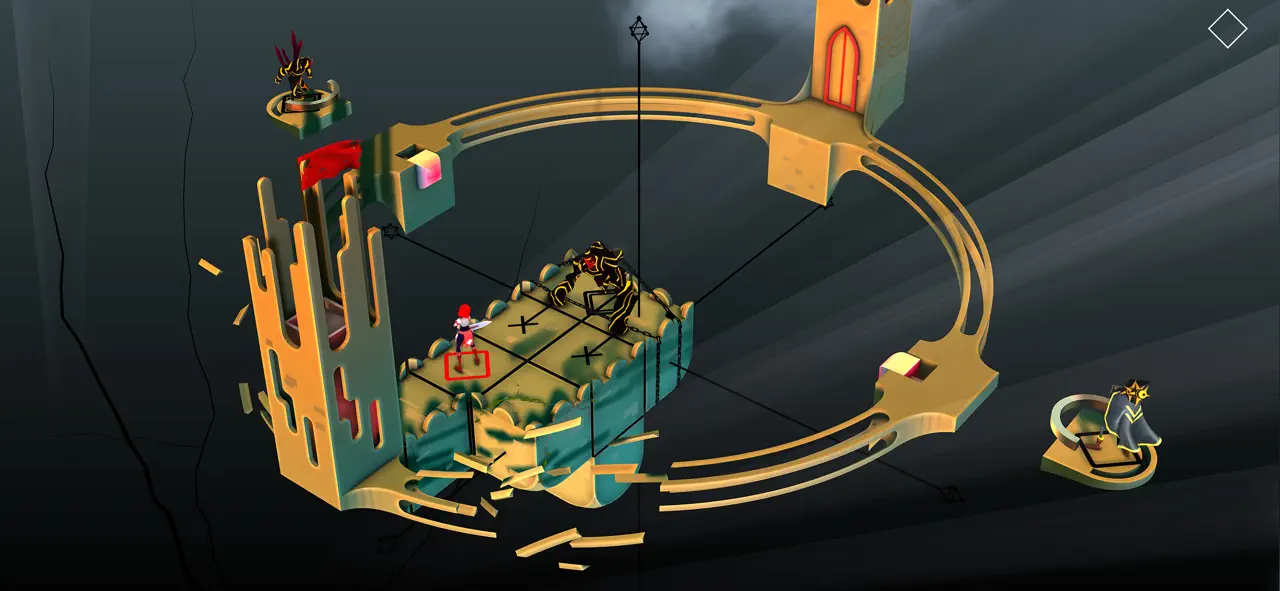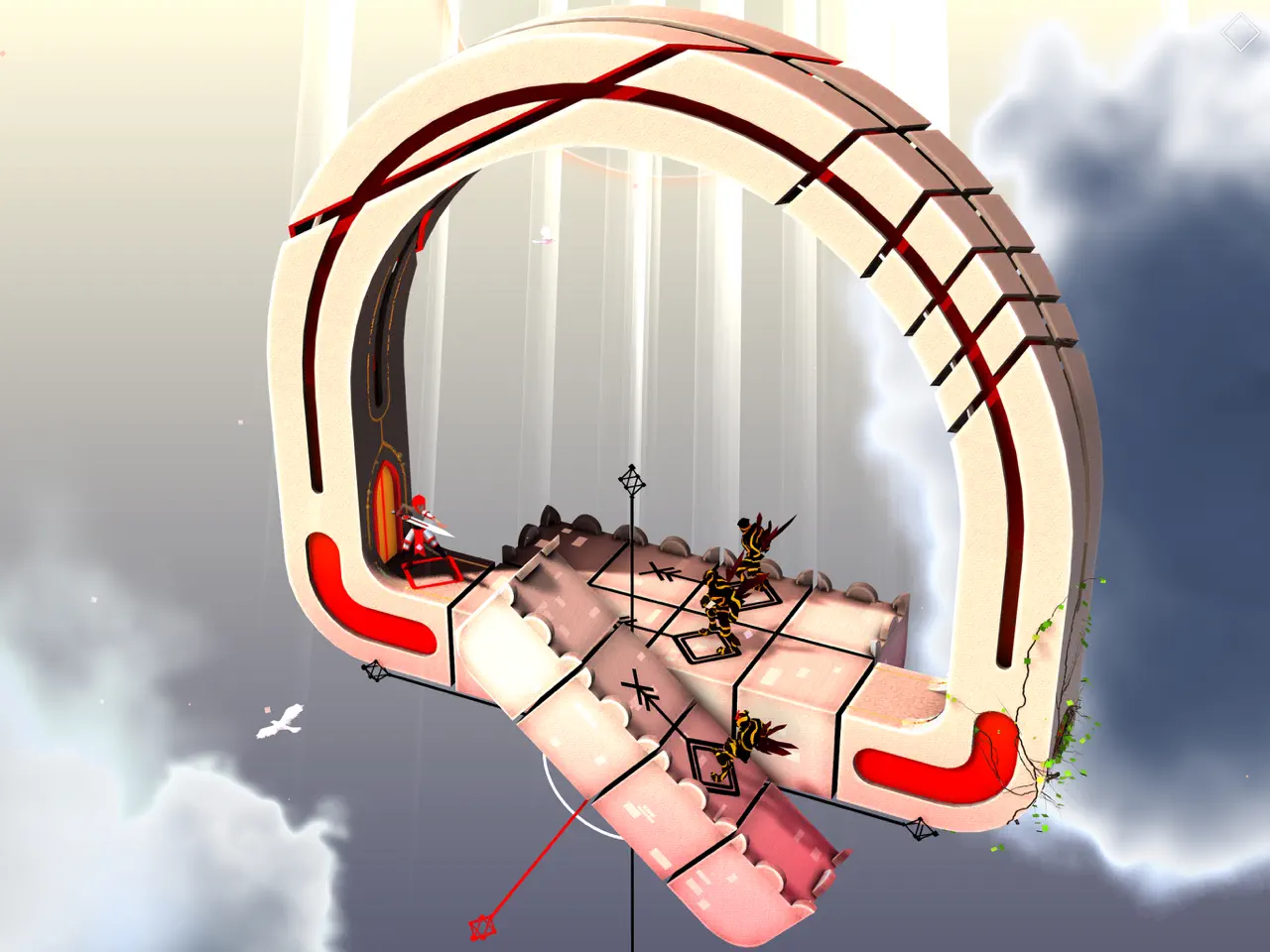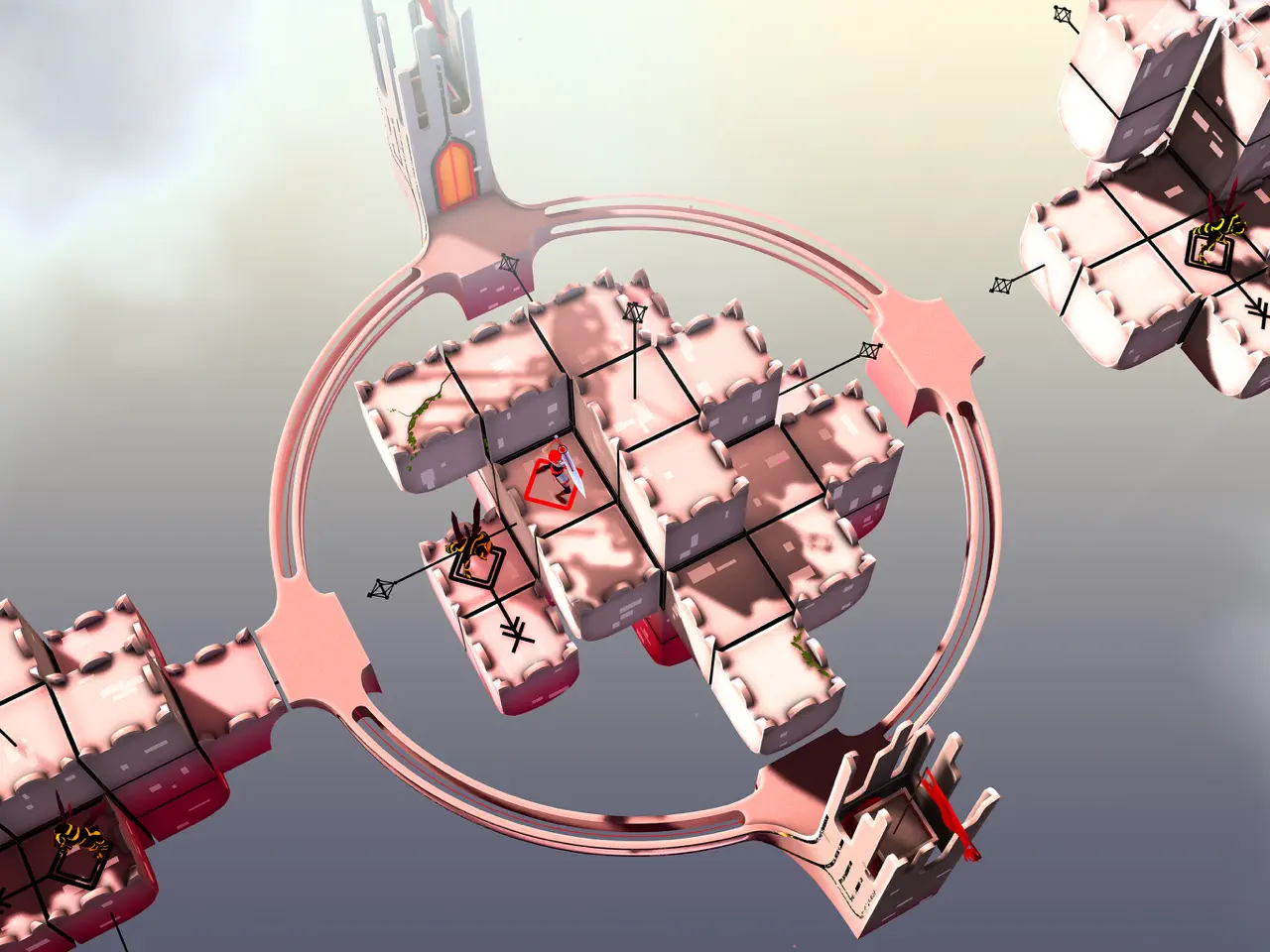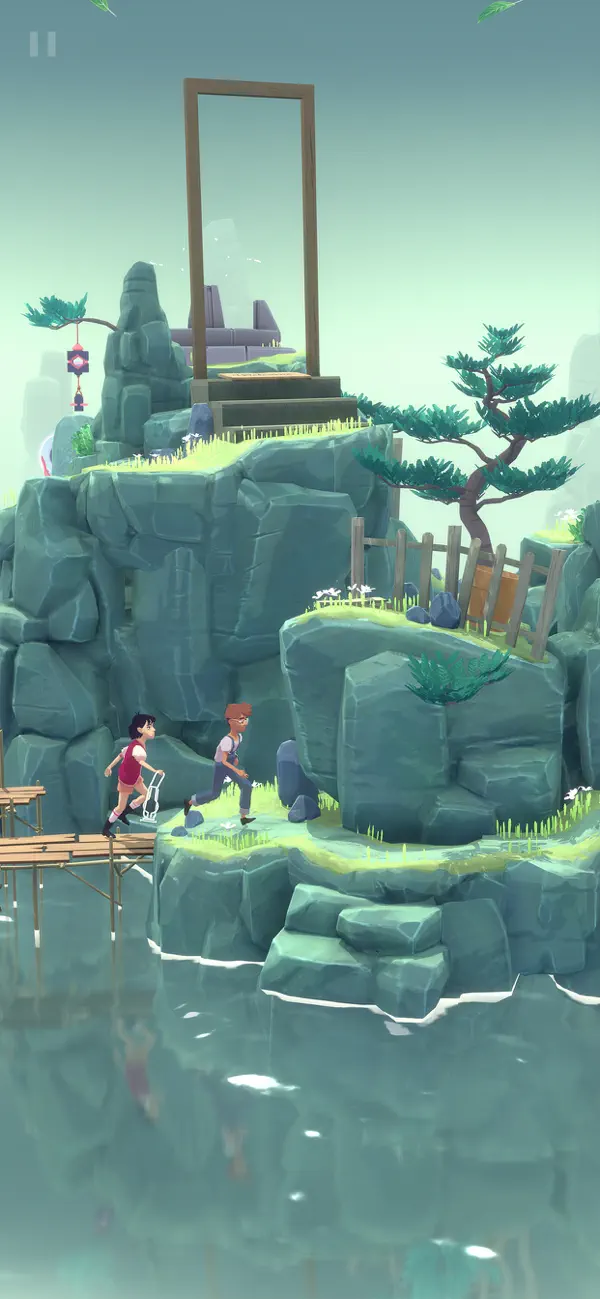
Euclidean Skies is a breathtaking achievement in mobile puzzle design, serving as a superior sequel to the already excellent Euclidean Lands. It takes the core concept of shifting 3D architecture and elevates it to a level of complexity that is both daunting and incredibly rewarding. Each level is a floating masterpiece of geometry that you must physically manipulate—rotating rows and columns like a Rubik's Cube—to position your warrior for a strike or to navigate to an exit.
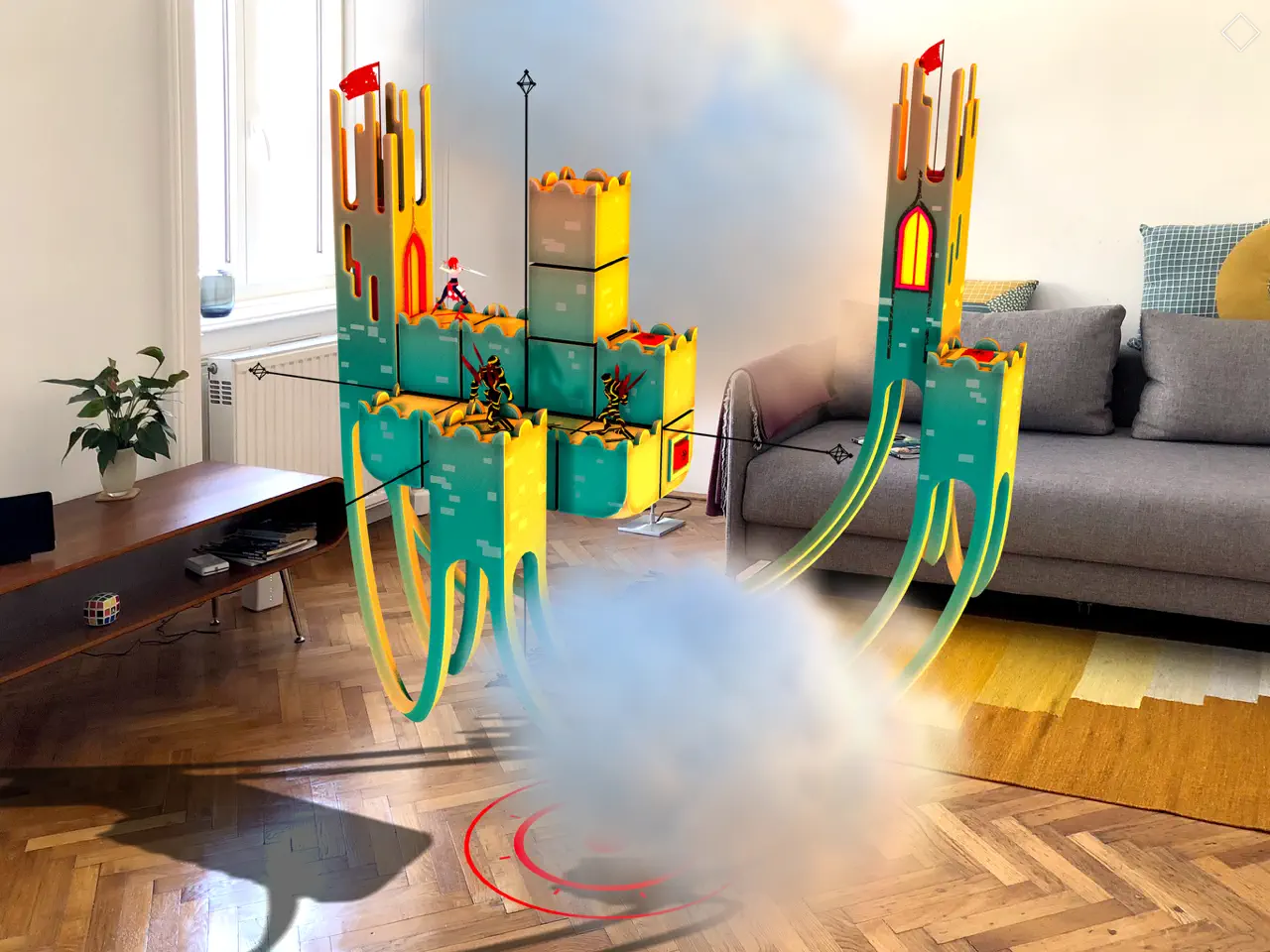
The addition of more organic, flexible structures means the puzzles can now warp and bend in ways its predecessor couldn't, leading to some truly 'aha!' moments. The game also includes an impressive AR mode, which lets you project these floating castles into your living room, allowing you to walk around and inspect the puzzle from every angle. With its gorgeous orchestral score and clean, minimalist art, Euclidean Skies isn't just a game; it's a piece of interactive art that challenges your spatial reasoning in the best way possible.
It is rare to find a mobile title that attempts true mechanical ambition, but Euclidean Skies succeeds more often than it fails. Building upon the legacy of Monument Valley, it demands that the player think in three (and sometimes four) dimensions. The ability to twist and distort the level architecture to flank enemies is genuinely brilliant, leading to 'aha!' moments that are highly satisfying. However, the game's greatest strength is also its Achilles' heel. As the levels become more complex, manipulating the camera and the architecture simultaneously on a touch screen becomes fiddly and frustrating. I often knew the solution but fought the swipe controls to execute it. Furthermore, the inclusion of boss fights feels misplaced in what should be a methodical puzzle game. Still, it is a premium, beautifully crafted experience that respects the player's intelligence—a rare commodity.
Performance: Runs well, though the AR mode is mostly a gimmick that drains the battery rapidly.
Buy if: You enjoy spatial puzzles, Rubik's cubes, and premium mobile games with no ads.
Skip if: You have poor spatial awareness or get frustrated by imprecise touch controls.
Available on: iPhone, iPad, iPod
Version 1.5Wed Mar 25 2020
* ENDLESS MODE with procedurally generated levels!
* Tutorial section
* Improvements and fixes
Requires iOS 11.0 or later. Compatible with iPhone, iPad, and iPod touch.The successor to the highly acclaimed Editors’ Choice-winning game Euclidean Lands is here!
Euclidean Skies combines marvellous architecture and turn-based movements to create a beautiful world with mind-bending puzzles.
The game’s focus is on shifting and rotating, challenging you to think about the breathtaking structures from multiple viewpoints at once.
When using the spectacular AR* mode, fantastic castles will float in your living room, right in front of you.
Twist and turn the architecture to outmaneuver enemies and guide the heroine to the exits of 40 elegant levels.
Designed for all ages, Euclidean Skies evokes the feelings of a physical toy, where the joy lies in the act of play. While it’s possible to play the game with efficiency in mind, playing around with different shapes and forms, without the pressure of solving a level, can be truly satisfying too.
Features:
● 40 hand-crafted levels with mind-bending puzzles
● Fierce boss fights
● Beautiful AR mode
● Special achievements for ambitious players
● Skip-a-level option for impatient players
● iCloud sync across all your devices
*The augmented reality mode can be switched on and off, at any point, without interrupting the user experience.


Euclidean Skies combines stunning architecture and tense turn-based gameplay in a world of floating geometry. Players must rotate and shift the structures of the world to create paths, defeat enemies, and solve complex spatial puzzles. Building on the success of Euclidean Lands, this sequel introduces more intricate mechanics where levels can be twisted and transformed into new shapes. With 40 handcrafted levels, breathtaking visuals, and a full AR mode that lets you explore the puzzles in your own space, it's a masterpiece of logic and design.
Innovative structure-shifting mechanics
40 complex, handcrafted levels
Immersive AR mode for spatial gameplay
Beautiful orchestral soundtrack and visuals
Boss levels require multiple steps to dismantle the enemy's defenses. You must often rotate pieces of the environment to avoid being hit while looking for an opening.
Yes, you can project the puzzles into your real room and walk around them.
I usually have no patience for 'artsy' games, but Monument Valley is undeniably well-crafted. The way the levels shift and click into place is mechanically satisfying. It’s like playing with a digital Rubik's cube that looks like a watercolor painting. The puzzles aren't difficult—in fact, they're barely puzzles at all—but the sensation of discovery is constant. My main gripe is the length. For the price, it’s over in a heartbeat. It’s a 'prestige' game, meant to be admired for its aesthetics rather than its challenge. If you're looking for something that will test your brain, this isn't it. But as a showcase of what mobile hardware can do when it’s not trying to sell you coins, it’s impressive. It’s the definition of a 'short but sweet' experience.
I’ll admit it—I was skeptical. Turning Tomb Raider into a turn-based board game sounded like a recipe for disaster. But Square Enix actually pulled it off. This isn't just a mobile spin-off; it’s a brilliantly designed puzzle game in its own right. The 'GO' format works perfectly because it respects your time. Every move is a deliberate choice, and the puzzles escalate in difficulty at a perfect pace. The art style is the real winner here. It’s clean, colorful, and evocative of the classic PS1-era Lara while looking modern. It doesn't try to be a photorealistic action game, which is why it succeeds where others fail. My only gripe is that it’s a bit short. You can breeze through it in a few sittings, and the replay value is low once you’ve solved the riddles. But for the price, it’s a rare example of mobile gaming done right.
This is a rare case where the 'art game' label isn't just an excuse for lack of gameplay. The time-scrubbing mechanic is incredibly clever. It forces you to look at the environment not as a series of obstacles, but as a timeline you have to synchronize. It's elegant in a way most mobile games never even attempt. I’m usually a bit cynical about these types of emotional narratives, but the way the world-building happens through the objects on the islands—old VCRs, game consoles, bike parts—really struck a chord with me. It’s a short experience, yes, but it’s dense with quality. It’s one of the few games on the App Store that I would actually call a must-play for anyone who appreciates thoughtful design.
I've grown weary of modern puzzle games that hold your hand and treat you like a child. The Guides is the antidote to that. It’s stark, quiet, and genuinely difficult. It requires you to actually use your brain—and occasionally a notebook. The aesthetic is clean and fits the 'secret agent' or 'hacker' vibe perfectly. However, there are moments where the logic feels a bit too leap-of-faith for my tastes. A good puzzle should make you feel smart when you solve it, not like you finally guessed what the developer was thinking. While 90% of the game is brilliant, that final 10% can be a slog of trial and error. It’s a very specialized experience; if you aren't the type to enjoy looking up Morse code charts in your spare time, stay far away.
Golf Peaks is refreshingly honest. It doesn't try to be a simulation; it's a logic game wearing a polo shirt. The card-based movement removes the frustration of physics and replaces it with the satisfaction of a solved riddle. It's clean, quiet, and doesn't waste your time with unnecessary menus or flashing 'buy now' buttons. My only real gripe is that for a seasoned player, it’s over far too quickly. You can breeze through the core levels in an hour if you've got a decent head for spatial puzzles. It’s elegant and polished, but it lacks the 'one more thing' complexity that would make it a true classic. A fine way to spend an afternoon, but don't expect it to last much longer than that.
I've seen this game a hundred times before. It’s the kind of thing people play on the subway when they’re bored of looking at their own shoes. It’s functional, sure. The numbers move when you swipe. It’s 'zen,' I suppose, if your idea of zen is basic addition in a gray box. But let’s be honest: there’s nothing here we haven't seen in Threes! or 2048 a decade ago. At 40, I’m looking for innovation, or at least a high level of craftsmanship. This is just a template. It’s the 'white bread' of gaming. There’s no risk, no flair, and ultimately, no reason to pick this over the dozens of identical apps that already exist. It’s fine for what it is, but what it is happens to be completely redundant.
Boxville is a breath of fresh air in a marketplace full of generic assets. The art is stunning—every screen looks like it was painstakingly sketched by hand, and the world of sentient cans is surprisingly evocative. It reminds me of the old Amanita Design games like Machinarium, where the atmosphere does the heavy lifting for the story. The decision to remove all text and speech in favor of pictorial bubbles is bold and, for the most part, works well. However, the 'show, don't tell' philosophy can lead to some serious frustration. Some of the puzzles are obtuse, and because there's no text, the clues can be easy to misinterpret. I spent twenty minutes clicking on a thread-needle electricity pole because I didn't realize a tiny interactive zone was hidden in a shadow. The UI is also a bit too minimalist for its own good—sometimes you aren't sure if you've actually exited a menu or just moved to a sub-screen. It’s a great game for patient players who appreciate art and atmosphere, but it lacks the polish and guidance to make it a true all-time classic.
Dinsun here. I don't say this often, but this is a proper game. Loco Looper doesn't beg for my attention with notifications or microtransactions. It just presents a puzzle and asks me to solve it. It reminds me of the old logic puzzles I used to do in magazines, but with a sleek digital interface. The difficulty curve is actually well-balanced—it starts easy enough for anyone but gets genuinely head-scratching in the later stages. My only gripe is that it can feel a bit clinical. A bit more personality wouldn't hurt, but I'll take clinical over 'predatory mobile trash' any day of the week. It’s a solid buy for anyone who likes to actually think while they play.